
Rabbits are an interesting and profitable occupation. But at the same time, every rabbit owner has a number of questions about the care and maintenance of animals. The period of raising young animals is difficult. Experienced breeders also consider the time when grown-up and strengthened rabbits have to be weaned from their mother to be a difficult task. At first glance, everything is simple. But in fact, every farmer needs to be familiar with the nuances of how and when to wean rabbits from a rabbit.
At what age?
There is no unequivocal opinion among farmers about the age at which young rabbits are reared.
As you know, lactation in a female after mating can last up to 2-3 months. But in practice, females do not feed their babies for more than a month and a half, because they already show a desire to mate again and become pregnant. And the grown-up cubs from the 24th day eat more and more adult food, suckle less, accordingly, the secretion of milk fades.
If we take into account that at 24 days, little earwigs are still half dependent on mother’s milk, and by day 35, the role of milk in the diet is only 7%, then weaning at this time is logical. But it is worth noting that babies usually gain 500 g of weight in a month, and can get by only on plant food and compound feed.

Therefore, in the case of withdrawal, they focus on the age of the younger generation and the material base:
- 24-28 days is the minimum acceptable age when the baby rabbits are weaned, provided that their baby teeth have completely changed and they are actively eating adult food;
- creation of comfortable conditions for living with ears (spacious, clean, disinfected cages) and a completely balanced diet that is suitable for this age.
Video at what age it is better to wean baby rabbits from a rabbit:
When to retire depending on the goals
Weaning from a rabbit should be carried out quite carefully. Proper weaning in the first months of life affects the growth, health and development of the cubs. Usually, deposition by age is done, taking into account the density of the ocrol:
- With compacted collars. Those litters when a rabbit is mated with a male 2 days after giving birth are called compacted litters. With such a schedule, the rabbits should be taken away from the female from 24 to 28 days after birth, so that the mother can rest for a couple of days before the new litter.
At the same time, the conditions for the weight of rabbits are put forward: rabbits for skins and fluff must gain a body weight of 400-550 g, animals of the meat-skin direction – 450-670 g, and those individuals that will go for meat – from 500 to 750 g.
- With semi-sealed collars. Semi-compacted litters are considered when mating is carried out 14-20 days after birth. With this schedule, the rabbits can stay with the nurse for up to 35-40 days. This method is more humane, because the reproductive system of the female and her internal reserves are better restored.
- When feeding on meat. Meat rabbits can be weaned from their mother at one and a half months, when they will strengthen well and actively begin to gain muscle mass. This method of selection is gentle on the cubs and the rabbit. Animals grow large, have high resistance to diseases.
- The broiler method. Breeds of rabbits for which the broiler method is used include, for example, such breeds as Californian or French Ram. Such earwigs are weaned from the mother’s cage no earlier than 65 days, and the mating of the mother is carried out on the 50th day after childbirth.
The main methods of precipitation
It is recommended to wean the rabbits from the rabbit in the following ways:
- Simultaneous deposition. This method can be used for compacted collars for monthly offspring. The entire brood is simultaneously transplanted into prepared cages and given good vitaminized food with mineral supplements. Sometimes, in order to reduce fear in children, they are left in their parents’ house, and the female is transferred to another rabbit hutch.
- Weaning with periodic trimming. This method is rarely used in practice. But usually the offspring are moved from the new home to the mother’s cage and back, if it is not possible to provide full nutrition to the eared ones or they develop slowly.
- Sorting by degree of development. If the female has a lot of milk, then the cubs are weaned as they develop. First, the strongest individuals are selected, after a couple of days – other, older ones. Do not use this method for compacted collars.
Weaning of rabbits, how and when it is better to wean.

Measurement of rabbit parameters after weaning
When weaning, the anthropometry of the rabbits must be carried out: they are weighed, sex is determined, and health is assessed.
- The body weight of the rabbit should approximately correspond to the requirements for age and breed.
- You can find out the sex of the rabbits from the 20th day after birth. Earwigs are placed on their backs, their tails are pulled back, and their sex is checked: in females, the genital organ is located close to the anus, and in males, the penis is similar to a larger hole and is located far from the anus.
It is important to determine whether the baby is healthy during this period.
Signs of a healthy bunny:
- the animal is lively, active, there is a reaction to sound, light, touch;
- good appetite;
- the nose is clean, there are no secretions;
- eyes are bright, shining;
- the wool coat is clean, smooth, without bald spots, with a light ebb and flow;
- body temperature is normal (38-39 °C);
- rhythmic breathing (50-60 times/min);
- the pulse is accelerated, rhythmic (125-165 beats/min).
Rabbits with developmental delays are recommended to be housed separately from their healthy relatives. To make them stronger, they are transferred to highly nutritious feed. Severely weakened animals are culled by slaughter.
Do you need to plant rabbits by sex?
Rabbits reach sexual maturity at about 3 months of age. Therefore, until this time, the rabbits can be with the nurse (if she was not connected) or separately in a group cage. But in order to prevent family pairing, at 3 months it is necessary to separate the rabbits by gender – boys and girls separately.
Where to drop off babies
Young rabbits should be placed only in clean, disinfected rabbit hutches. Rabbits should feel freedom in their new home. The cages are spacious, dry, and warm for babies so that there are no drafts. It is better to make the bottom of the house wooden or plastic. Wood sawdust, soft straw, pieces of fabric or cardboard are suitable for bedding. The bedding material should be dry, without rotten inclusions and parasites.
Breeding individuals are recommended to be settled separately – immediately after determining the sex. Females that are planned for mating can be housed two or three in cages. But it is better to place male producers in individual housing, as they start to fight when they reach puberty.
For the rest of the offspring that will go to slaughter, one cage will fit – for 3-7 ears. 10-15 animals can be separated into aviary structures. It should be taken into account that for one rabbit, at least 0.2 m2 of the area of the rabbit hutch is laid out.
It is undesirable to combine animals from different litters in one cage. If absolutely necessary, it is better to place everyone together in a new house. Then the animals are observed for some time.
In order to prevent injuries, it is recommended to wean rabbits from the general group and transfer them to separate cages. But there is another opinion, a hierarchy is established among the rabbits, and by removing the leader (the bully), you will thereby provoke new fights for the first place. In this case, it is better to resettle rabbits that suffer more in fights.
It is forbidden to settle young animals with older relatives. Adult rabbits will fight with the younger generation, provoke unequal fights, drive them away from feeders. And this will affect the development, growth, may cause the death of growing offspring.
Feeding the rabbits and caring for them after weaning
After weaning, special attention is paid to the nutrition of rabbits. Despite the fact that animals at this age are adapted to adult food, it is worth monitoring its nutrition, frequency of intake, and quality.
After hatching, earwigs become very vulnerable. Due to the lack of mother’s milk, the acidity in the stomach decreases sharply during the first week. Therefore, if you immediately transfer the rabbits to rough adult food, it can cause inflammation of the gastrointestinal tract. Pupils will suffer from diarrhea, bloating, appetite will decrease or completely disappear. This condition can be fatal.
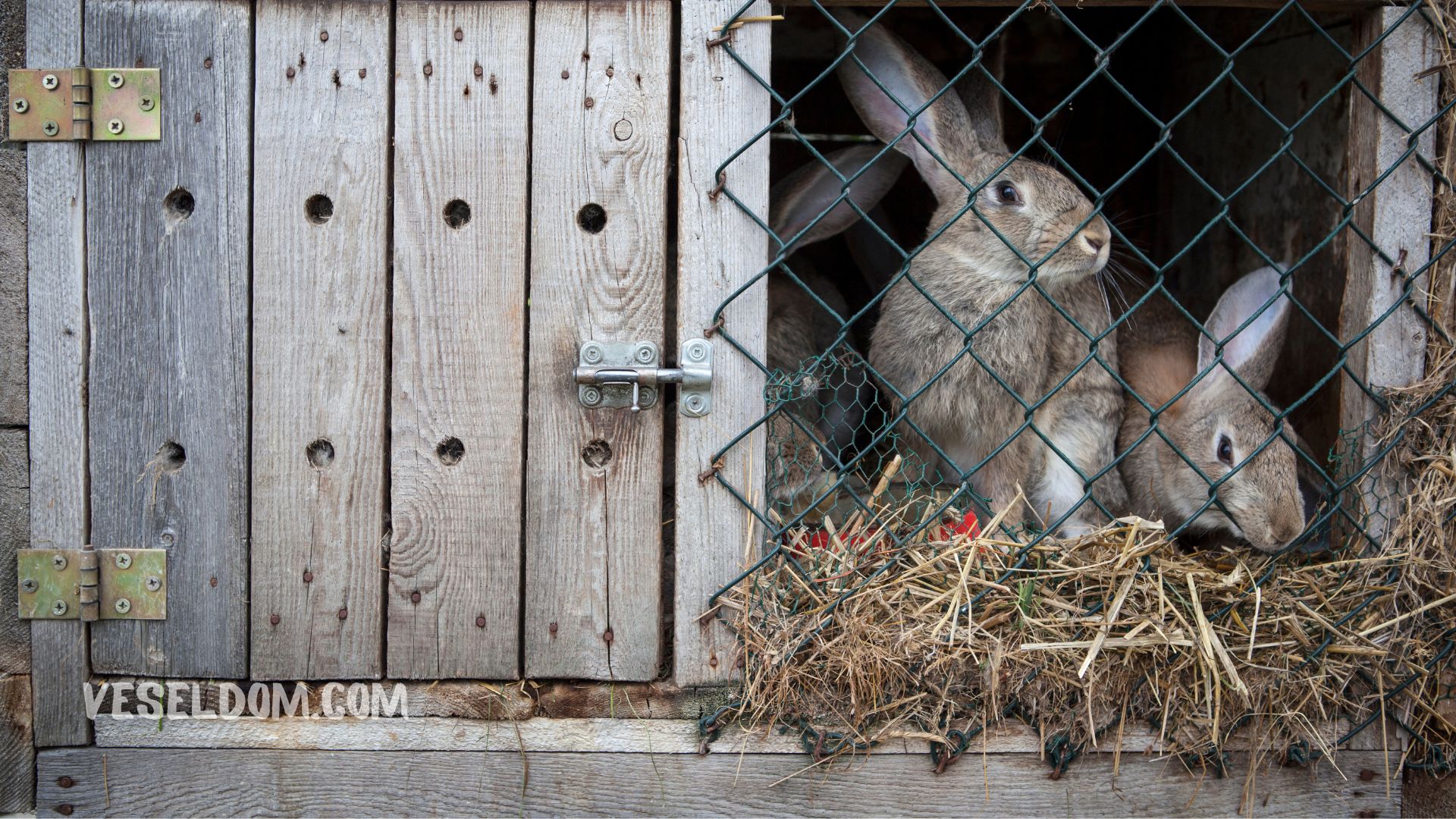
To avoid negative moments, after weaning, the rabbits are given the same food that they were introduced to in the mother’s feeder. New food is introduced gradually. In addition, it is worth monitoring the amount of food. Babies often overeat. Therefore, it is necessary to feed three times a day, in small portions according to age. Portions are increased every week.
A single portion of food for one rabbit in the period of 46-60 days is 100 g, in 61-90 days – 150 g, in 91-120 days – 200 g.
Feeds must fully meet the needs of fast-growing eared organisms. Young rabbits are given food rich in proteins, carbohydrates, and minerals. An excellent supplement is oat and rye grain. But it is better to exclude wheat and barley from the diet of young animals. They cause bloating, diarrhea, indigestion.
A good option is to feed the young with special vitamin and mineral supplements.
There should always be clean, warm water in the drinking bowls.
To improve the digestion of rabbits, vitamin B is added to the water, based on the dosage – 25 ml of vitamin per 500 ml of water.
Also, brooms made of chamomile, St. John’s wort, and chicory help to restore the functioning of the gastrointestinal tract during the transitional period. This supplement also increases immunity.
But one should not forget that not only food is important, but also the conditions of keeping. Cleanliness and order in cages, space, free movement of animals – all these factors are important for the normal development of young offspring.
Weaning of rabbits is a very important stage in the life of eared rabbits. In order for the animals to go through this period painlessly, quickly adapt to new conditions and, as a result, please their breeders, very little is needed – good care and balanced feeding. Following certain recommendations, you can achieve great success in breeding an eared herd.