
After crossing several types of chickens, a special type of poultry was bred – broiler chickens. They quickly became popular among farmers due to their rapid growth and weight gain. Birds are kept for their tasty and tender meat. And what about eggs? – you ask. Let’s consider whether broilers lay and how many eggs can be obtained from them in a year.
How do broiler chickens lay? And do broilers rush at all? This question is of interest to any beginner farmer. Poultry lay eggs in the same way as all other types of chickens. But the profitability of the egg business from broilers is not high:
- The formation of the reproductive system ends by the eighth month of life, while the bird reaches the weight required for slaughter by two months.
- Most of the testicles are two-yolk. Chickens do not appear from them.
- Broiler chickens produce eggs that are too large in size, which leads to injuries. And this entails illness and even death.
- You can get no more than two eggs per week from a broiler. And this is not the best indicator.
- After the bird reaches the reproductive age, the taste of the meat deteriorates.
Meat chickens are slaughtered before the third month of life. This happens because after three months the chickens continue to eat, but they no longer gain weight. But if the bird has not reached the required weight, it can be left for egg production.

When they start to fly
Broiler chickens at home start laying from 8-9 months of life, while egg-laying chickens give results from 4-5 months. But broiler breeds rarely live to this age.
How to get eggs from broilers
Breeding hens and broilers by crossing the Cornish and Plymouth breeds. The resulting hybrids grow quickly, but, unfortunately, do not inherit the parental genetic characteristics. The productivity of birds is not high and can lead to the death of birds. If the farmer still decides to keep the chickens for egg production, he must follow some rules:
- Food should be balanced.
- Birds are prone to obesity, so you will have to follow a diet.
- Chickens should be fed no more than three times a day in small portions.
- There should be a lot of fresh greens and shellfish in the diet.
- Poultry should be regularly shown to the veterinarian, as birds are prone to diseases.
- The poultry farmer must monitor the condition of the chicken. If she refuses food and water, this may indicate problems caused by large eggs.
Note! Products with a double yolk are good, but with the onset of egg-laying age, the poultry meat becomes hard, dry, and has a specific taste.
Egg-bearing breeds
Chicken meat is gaining popularity every year. Scientists are breeding new meat breeds. And do broiler breeds lay eggs? The answer is yes. The best breeds:
- Ross-308. A good fast-growing breed. With proper feeding and compliance with all maintenance rules, the bird adds 55 grams every 24 hours. Laying hens produce a record number of eggs among hybrids – 185 eggs per year.
- Ross-608. The peculiarity of the breed is that even after the bird reaches reproductive age, the meat does not lose its taste. In a year, you can get up to 140 pieces from 1 individual.
- Cobb-500. By four weeks, the individual reaches a weight of 2 kilograms. The average carrying capacity is 160 pcs. for a year. The maximum recorded productivity is 182 pcs.
- Broiler-M. The average weight of an individual is 2.6 kilograms. The reproductive system is formed quickly. Birds start to lay before 5 months. The average number of eggs is 162 pcs. for a year.
- Broiler-61. The breed is characterized by rapid growth with poor nutrition. An individual gains approximately 40 grams per day. Up to one and a half months – 1.8 kilograms. In a year, you can get up to 155 eggs from a broiler of this breed.
- Hybro-6. By one and a half months, it weighs 1.5 kilograms. Productivity – 145 pcs. for a year.
- Change. One of the most popular breeds. Derived by crossing Broiler-6 and Hybro-6. Poultry of the Zmina breed have intensive growth, the weight gain of which can reach 40 grams per day. Laying is average – 140 testicles per year.
Collection and storage of eggs
Experienced farmers recommend collecting products twice a day: the first time after morning feeding, and the second time in the afternoon – to avoid cracking the eggs and to keep the shell clean.
Collection of egg products is carried out with clean hands. With two fingers, the testicle is taken by the blunt and sharp end and moved into the container.
Note! Why can’t you take an egg with the whole palm? The shell is covered with a thin membrane that protects against the penetration of bacteria and microorganisms. Taking the egg with the palm of the hand, the farmer damages the shell, which increases the risk of infection.
Eggs can be stored for five days. During this period, the nutritional value will not be lost, and the chicks will be able to hatch. After the fifth day, the yield decreases by 4%.
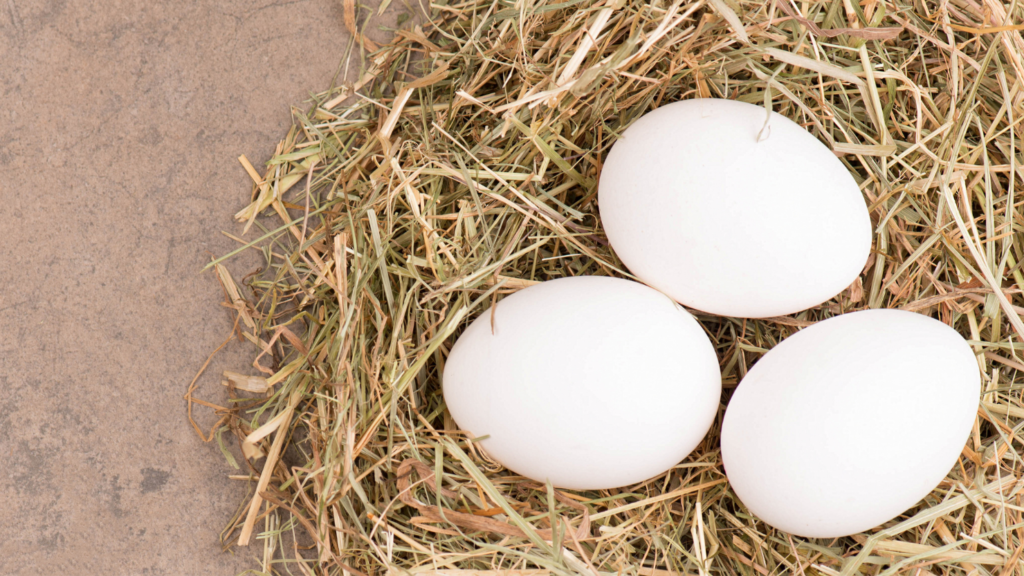
Types of testicles
Eggs of meat birds are used both for food and for breeding offspring. The offspring of broiler chickens are characterized by high mortality. Therefore, special skills are required for breeding birds.
Food
Egg production in meat chickens is large. It is important to carefully inspect the shell for cracks. Eggs may contain harmful bacteria and microorganisms, so it is better not to use them as food.
After collecting eggs for food, they are carefully wiped with a clean cloth, removing excess dirt from the shell. Already cleaned products are placed in a dry container and stored at a temperature of 0˚С.
Incubation
Broiler chickens lay eggs, but are completely devoid of maternal instinct, so a special incubator will be needed to breed the breed.
Note! A broiler will not hatch from a broiler egg. They come out exclusively by hybridization.
At home, hatching a broiler from an egg is quite a chore and requires certain skills and abilities. It is better to buy hybrid chicks from experienced and proven breeders.
After some time, the contents of the egg begin to evaporate through the pores in the shell. Therefore, hatching eggs cannot be stored for a long time. Over time, the concentration of salts increases, which reduces the probability of hatching offspring.
Hatching eggs should be stored at a temperature not higher than 18 ˚C and air humidity not higher than 80%. If the temperature is too high, the development of the embryo slows down, if it is low, the hatchability is reduced by two times.
To maintain optimal conditions, it is necessary to equip the incubation room with artificial heating for the winter period and a cooler for the summer period. An air conditioner is used to normalize humidity. If it is not possible to equip the room with an air conditioner, you can use a folk method – place a tray with water over the eggs.
The room should be darkened, with good ventilation. Eggs are stored vertically, with the blunt end down. If the egg has been without an incubator for more than three days, it will have to be turned over to avoid sticking the yolk to the shell.

Maintenance of egg-laying broilers
Broilers are sensitive to improper care and maintenance. They are prone to diseases. Poultry care rules:
- The birdhouse should be clean, with sufficient lighting. A litter of sawdust or hay must be laid on the floor. Drinkers must be filled with clean water. Unlike egg-laying birds, butchers should not organize free range, as it can be dangerous for the health of individuals.
- In order for egg-laying to take place without consequences, laying hens should regularly massage their abdomen. Then the testicle will come out easily, without causing injury to the fallopian tube.
- It is recommended to exclude drafts. Birds have weak immunity.
- If the bird is grown for meat, movement is restricted. Promotes rapid weight gain. If the broiler should lay eggs, they are encouraged to move more, as obesity reduces productivity.
- Poultry breeders must vaccinate their flock.
- It is better to choose industrial food, as it contains the necessary vitamins and trace elements necessary for the proper growth and development of the broiler.
- Broiler chickens need to be fed every two hours to gain weight.
- If the hen is left to produce egg products, feeding is reduced to three times a day.
- In order to improve the quality and taste of the meat, two weeks before slaughter, the individual is fed unlimited amounts of fresh grass.
- As the birds intensively gain weight, their bones may not withstand the load. Therefore, calcium should be in the diet of birds. To increase the amount of trace elements in the body, crushed mollusk shells, shells and chalk are added to the food.
Breeding broilers is not an easy task. Especially if the farmer wants to get egg products. Before starting the breeding of meat birds for the sake of eggs, you need to consider everything and consult with experienced poultry farmers.