
Cultivation of highly productive meat breeds of poultry is a top priority for many private breeders. The reason for this is that geese, turkeys, broiler chickens and other large birds allow you to get a lot of delicious tender meat to the table quite quickly. Breeding of broiler chickens is considered the most economically profitable, but this bird is quite demanding on nutrition. Let’s consider what to feed broilers correctly in order to get a lot of dietary meat grown in environmentally friendly conditions.
Peculiarities of feeding broilers
In an individual farm, broiler cross (note: cross is a specially bred line of chickens with unique characteristics peculiar only to them) is bred exclusively for the purpose of obtaining a large amount of meat. It is well known for its precociousness, able to gain weight quickly, but is also very demanding on nutrition. To get a good result, you need to know in advance what to feed broiler chickens. It is not uncommon for all livestock to die unexpectedly due to the farmer’s inability to prepare his ration correctly. And sometimes the reason is the desire to diversify it.
A specially bred line of chickens is often characterized by weaker immunity, lack of resistance to certain diseases and other important parameters. Most breeds bred for economic purposes are adapted only to certain special conditions of keeping.
That is why the poultry farm is considered the “homeland” of broilers. After all, not every home poultry house is able to provide them with the proper conditions, starting from a constant temperature and ending with a diet.

The main advantage of broilers is a fairly rapid weight gain compared to traditional chicken breeds. For this, three different feeding options are used depending on the age of the bird. Chicken feed is divided into the following categories:
- Starter – lasts from the moment the chickens are born to the age of two weeks. It is a very important stage in which the young get a supply of health for the rest of their life.
- Rostov – the next two weeks of the life of a young broiler. The key goal is the activation of biological mechanisms that help the bird to build muscle mass faster.
- Finishing – the chicken is actively fed for the fastest possible weight gain. In addition, do not forget that it is during this period that the final taste of the meat is formed, depending on the chosen diet.
It is believed that the broiler cross is exclusively compound feed and adding other products to it is not only unnecessary, but even harmful. In fact, the main condition for the good health of the flock is the ability to properly balance the nutrition of chickens. Any miscalculations will immediately have a negative impact on the bird due to its very sensitive immune system. Therefore, consider that even an adult representative of this breed is not always able to survive “experiments” with the diet without consequences.
Note! It is easier and safer to choose compound feed offered in specialized stores. But there are other decent diet options that improve the taste of meat.
Combined feed
Compound feed is a key basic element of nutrition for a large number of broilers in a poultry factory and in a household. But even in this case, the key condition for successful breeding remains a properly selected nutritional proportion. The option of simply pouring and forgetting is not suitable for a private breeder, because:
- At the factory, chickens are weighed every week in order to find out the optimal amount of feed for the next week.
- A universal balanced food product of a poultry farmer is a utopia. A special mixture is selected for each period of the bird’s life, which helps to provide it with everything necessary for rapid growth.
- Strict dosage of food is an important condition on which not only growth depends, but also the health of young animals.
All this is possible at home, but it is associated with additional costs of time and effort. Therefore, although dry mixtures are convenient, as they simplify the care of chickens, the preparation of a wet mixture is considered by many breeders to be a better option. This is especially relevant for cases of purchasing products of dubious quality, which can in some cases cause not only disease, but also the extinction of livestock.
The advantage of high-quality combined feed is that the chickens will start to grow on it as quickly as possible. And the option of using a concentrate of protein-mineral-vitamin supplements will help to additionally reduce food costs by 20 percent while maintaining a similar result. This combination is considered universal for poultry farms of any size.
A mixture
Wet fodder mixture or mixture is considered the best option for a small farm with no more than 100 animals. Its main advantage is the opportunity to save, by adding water to feed, a part of unused products from the table and unspoiled food waste. But in order to avoid problems with the bird’s health, it is recommended to use only recipes tested by other breeders, because not every mixture that is given to ordinary chickens will be equally useful for broilers.
Dry fodder is used to prepare the mixture, which is poured with water, broth or dairy products in the proportion of 1 kg of dry mixture per 0.5 liters of liquid. At the same time, it is important to remember that until the chickens reach the age of two weeks, it is contraindicated to give them raw water – only boiled water. Its temperature is no less important – adult chickens can also get sick from cold water. The most correct decision will be to invite a veterinarian to your poultry farm, who will help you compile a list of optimal food products, starting from those available at your disposal.
Importantly! Sometimes the transition from dry feed to wet mixture results in a delay in weight gain for up to two weeks. This situation is caused by the processes of rebuilding the bird’s body for maximum assimilation of the nutrients of the new diet.
Dairy products
Dairy products are most useful primarily for chickens. Moreover, at the start, the instructions for correct dilution even strictly recommend the preparation of a mash, the basis of which is whey, abrat or low-fat kefir. In the future, the benefits of sour milk not only do not decrease, but on the contrary, they only increase. The period of active growth requires providing the body of birds with the required amount of calcium and protein, which are quite abundant in dairy products.

Green
Greens are a natural source of vitamins for the chicken, but it is not recommended to turn them into the main element of nutrition. It is impossible to offer it to the chicks immediately, and in the future, when offering greens, it is better to dry and grind them first. Combined feed mixtures for broilers are considered the main, and according to the opinion of some breeders, the only safe option for nutrition. However, you can safely offer them, starting from the second week of life:
- chopped dandelions;
- dry nettle;
- alfalfa;
- a little green peas – up to 3 grams per individual;
- herbal flour;
- green onion – helps to destroy the pathogenic intestinal microflora.
Monotony of the diet can harm livestock no less than experiments with unusual nutrition. Broiler cross is specially bred as birds capable of gaining muscle mass at maximum speed. The list of nutrients necessary for this has been known for a long time, so special mixed feeds always provide a faster increase in muscle mass than any “home” recipes. Another thing is that the latter help give the meat new shades of taste, fundamentally distinguishing domestic poultry from factory poultry.
Feeding norms at different ages
Maintaining broiler stock at each stage requires certain financial and time costs, which vary depending on the age of the stock. To feed an adult bird from the moment it emerges from the egg is impossible for many breeders due to the requirements for caring for newborn chicks. The number of feedings varies depending on the age of the bird as follows:
- A newborn chick is fed 10-25 grams every two hours 8 times a day for the first week.
- In the second week, the chicks are fed 6 times a day, the appetite of the chicks increases strongly – they are able to absorb up to 100 grams of feed.
- The third week simplifies the breeding process a little – it is enough to feed the stock 4 times a day.
- Starting from the age of one month, it is enough to give food to chickens twice a day at the rate of about 150 grams of feed mixtures for each individual.
Note! It is important to know in advance what to feed a broiler at each stage of its life. There is no universal recipe for feed mixture. But there are a number of recommendations proven in practice that help raise healthy livestock, in which the age of the bird plays a key role.
From 1 to 14 days
Chicks that have just hatched and are on their first day of life need special attention. The main conditions are eight meals at regular intervals, warmth and the right selection of the nutritional mixture.
The optimal solution for the period from 0 to 5 days of life for breeding broilers is the purchase of pre-start compound feed. It dissolves well in water, helps to provide babies with the necessary set of nutrients, and its protein and vitamin composition is optimally balanced for feeding broilers. The optimal portion size is 22 grams. Weakened chicks unable to feed themselves are recommended to the breeder to be fed by hand with egg yolk mixed with milk, using a medical pipette.
Eggs and dairy products are considered vital products at this stage. As an option, you can buy a special starter combined feed on corn, specially formulated for the proper development of chickens. For those who find the price of compound feed unreasonably high, the recipe for homemade mash is suitable:
- finely ground corn (half of the total weight of feed);
- finely ground wheat – 15% of the total mass;
- cake or meal also no more than 15%;
- milk base – obrat, low-fat kefir, whey, which are 12%;
- ground barley – 8% of the mixture.
The grain must be ground, as the delicate digestive system of small chickens cannot cope with large fractions of solid food. That is why many dry starter compound feeds outwardly resemble homogeneous dust – for better assimilation of substances not strengthened by the bird’s digestive system.
Starting from the second week, it is necessary to add calcium to the diet of babies in the form of shells, bone meal, chalk, egg shells. All this is again crushed as much as possible for the reason described above to an easily digestible state.
If the season allows, the chicks can diversify their menu a little with dried herbs. But most farmers recommend refraining from such a step or use dried crushed plants as a last resort. The reason is that plant pollen, which is invisible to the eye and accumulated on the greens, can harm chicks. Therefore, in the spring and summer, especially in August (ambrosia flowering season), it is necessary to monitor the cleanliness of the greens intended for broiler food very carefully.
From 14 to 30 days
Upon reaching the age of two weeks, the daily number of feeding broilers is reduced to 4 times a day. Chicks become more independent, the maximum daily consumption rate increases from 25 grams to 120 grams. Corn mixes still remain a key food option, as the cereal is rich in calcium. The value of this property for two-week-old chicks is that this period is a time of their active growth and rapid weight gain. By the end of 4 weeks, they often weigh at least 1.5 kg and become omnivores.
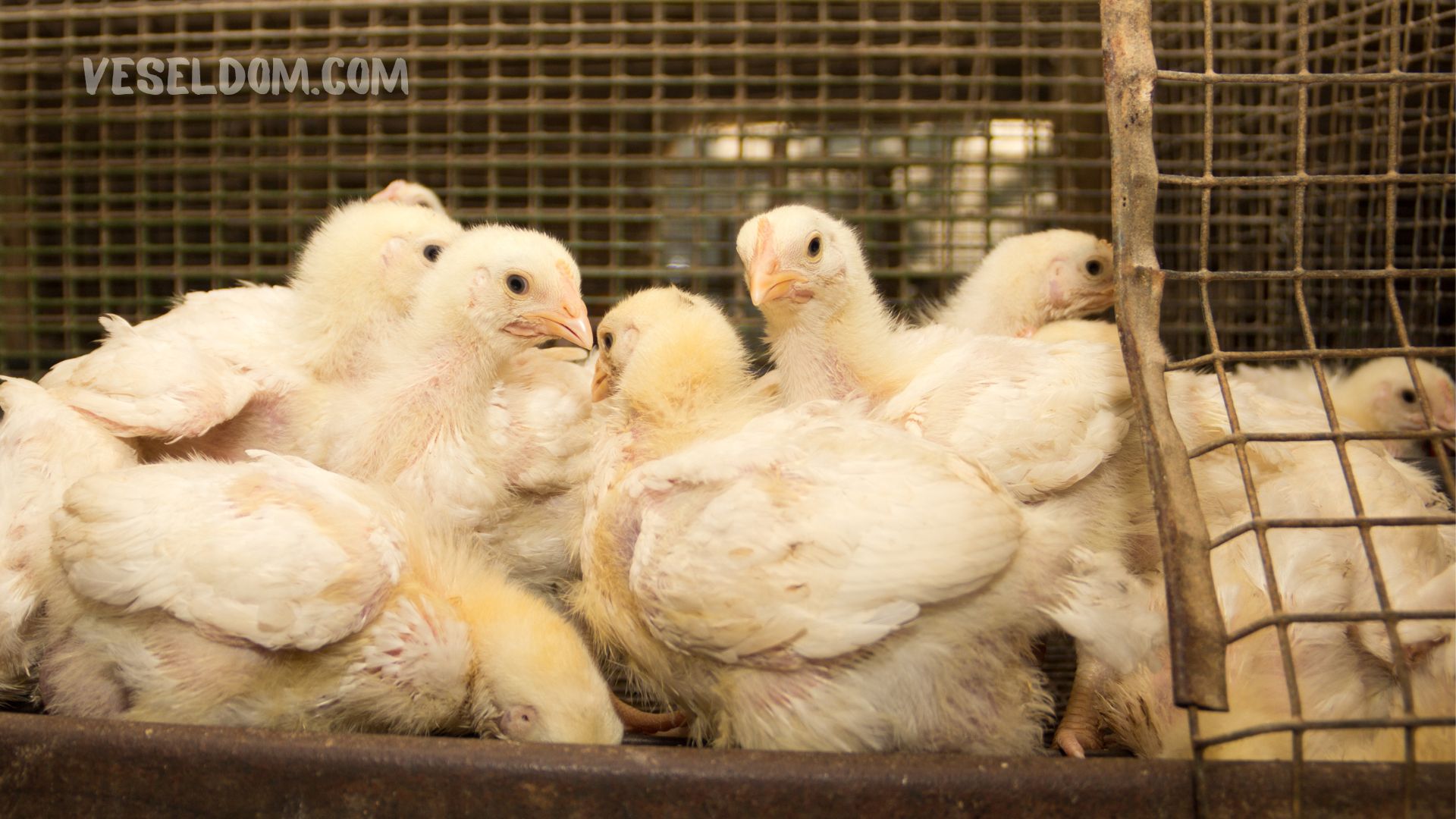
In order for a two-week-old broiler chick to become a fairly large, healthy bird by the thirtieth day of its life, you can follow the following recommendations:
- Mashed boiled potatoes can replace up to 20% of mash grain (including compound feed).
- The strong health of the stock will help to support ground fish waste in the amount of 5 (initially) to 15 (up to 30 days of life) grams.
- A good vitamin-fortifying vegetable is grated carrot or yellow pumpkin. They can be added at the rate of 5 to 30 grams per individual as they mature. But first you need to make sure that they do not cause digestive disorders in the chicks.
- A good result is provided by fresh cabbage.
- In this period, they begin to add yeast, bone meal, chalk, shells, quite a lot of dairy and other products rich in protein and calcium.
Preparation of homemade mixtures can be done not only on milk, but also on meat broth. The second option is considered even more priority, but with one important clarification – carefully monitor the freshness of meat and fish products, including liquid ones. To avoid problems with the intestines, you need to prepare a manganese solution in advance, and at the first signs of illness, water the livestock.
Note! A separate recommendation for this period concerns the prevention of coccidiosis. Veterinarians recommend adding vitamin B to the water for three days, and then watering young livestock with Baybox. The optimal dosage of vitamin B is a few grams per 0.5 liters of clean water.
From 30 to 45 days
In order for the month-old broiler chick to develop at maximum speed, it can either be transferred to natural products before this term or use special feed mixtures. The second option is a little more expensive, but the weight gain is significantly faster. Natural products slow down development a bit, but the final meat product is always tastier, and overall feeding costs are reduced.
Regardless of the chosen option, the basis of the diet remains crushed cereals. Often, poultry farmers, in order not to get confused in the recipe, use a mixture of peas, wheat, barley, corn and oats, mixed in equal proportions. It is dissolved in meat broth or milk whey.
A two-month-old broiler additionally receives not only grain, but also “green” mash. Mixtures alternate throughout the day, but always at the same time. Strict daily delivery of food at the same time is an important rule for rapid weight gain. Getting used to eating at the same time, the broiler begins to “prepare” in advance to receive and digest food. This acquired reflex helps to increase the assimilation of nutrients, as the digestive system of chickens will produce the necessary enzymes in advance by the scheduled time of day.
Feeding during the period of active growth
Many beginning breeders, when calculating the optimal amount of food for the broiler population, make a classic mistake – “the more, the better.” It is believed that since broilers grow quite large, they eat a lot. In fact, an adult bird rarely eats more than 180 grams per day, and how much of this is absorbed by its body depends on the farmer.
Despite the fact that the cost of compound feed is not suitable for everyone, it helps to accelerate the maturation of poultry as much as possible. In this case, it can reach 2.5 kg in just 45 days. Further feeding of broilers on purchased mixtures is economically impractical. “Home” recipes can cause a delay of a couple of weeks in achieving a similar result. The optimal composition of home finishing fattening:
- 25% each of wheat and barley;
- 20% each of corn and soy;
- 10% peas.

This mixture can be either finely crushed for soaking the mash, or given as a simple grain mixture. To improve the assimilation of mineral elements, you can add mineral substances, a small amount of cake, sunflower, yeast to it. Chalk must be added regularly regardless of the age of the livestock.
Note! It is very important to pour as much feed as the broilers can eat in an hour. Otherwise, the residues will start to sour and spoil in the feeder, causing bird diseases. This is especially dangerous for wet mixtures, which can sour very quickly in the summer heat.
What not to feed broilers
There is an opinion that broilers should be fed only factory mixtures. It did not arise out of nowhere – at an early age, chickens react quite sharply to improperly selected food products, up to death. There is a table of prohibited products for breeders that can cause illness and death. And most of these products from them seem safe to inexperienced breeders, because humans and other domestic animals can use them almost indefinitely. Most often, problems with broiler livestock are caused by the decision to add to feed:
- Products from the owner’s table. Any seasonings, including salt and sugar, are extremely harmful to poultry.
- Boiled potatoes in their pure form – potatoes can be part of the mixture, but no more than indicated in the recipe and only together with cereals.
- Water from under boiled potatoes cannot be used as a basis for a wet mixture.
- Bread and bakery products.
- Sausages, sausages, any smoked products.
- Peel of citrus and melon crops.
- Steamed milk – only low-fat natural dairy products are allowed, again not separately, but according to the recipe.
- Cheese, chocolate, jam, cocoa.
- Pure vegetable oil and butter.
- Any alcoholic products and fermentation products.
Even fine sand is dangerous for broilers because it can clog the bird’s goiter. Therefore, this improvised material, widely used in the creation of a sand bath for chickens, is not suitable for arranging a cage here.
Broiler cross is a breed bred for a long time, the subtleties of its cultivation are well known and tested more than once. Do not risk the bird’s life in vain. The rules for making up the ration described above help to grow large and healthy livestock as quickly and easily as possible.