
A greenhouse is not a complete protection for plants from diseases, although it isolates them from many external negative factors. Often, greenhouse owners have to deal with late blight and its consequences. Tomatoes and potatoes are especially affected by this problem. We will talk about potatoes separately, and today we will analyze how tomatoes are treated from phytophthora in the greenhouse.
What is late blight and why is it dangerous
The appearance of plant disease resembles a dense web. Phytophthora spores include mycelium, sporangium and conidium. The development of the fungus occurs directly in plant tissues, which complicates its detection and elimination. It develops there until the spore ripens, after which the shell opens and the spores move to other parts of the plant. A favorable environment for development is a temperature above 10 degrees Celsius. Treatment of the greenhouse from phytophthora is an important activity, since the greenhouse has all the favorable conditions for the development of the fungus.
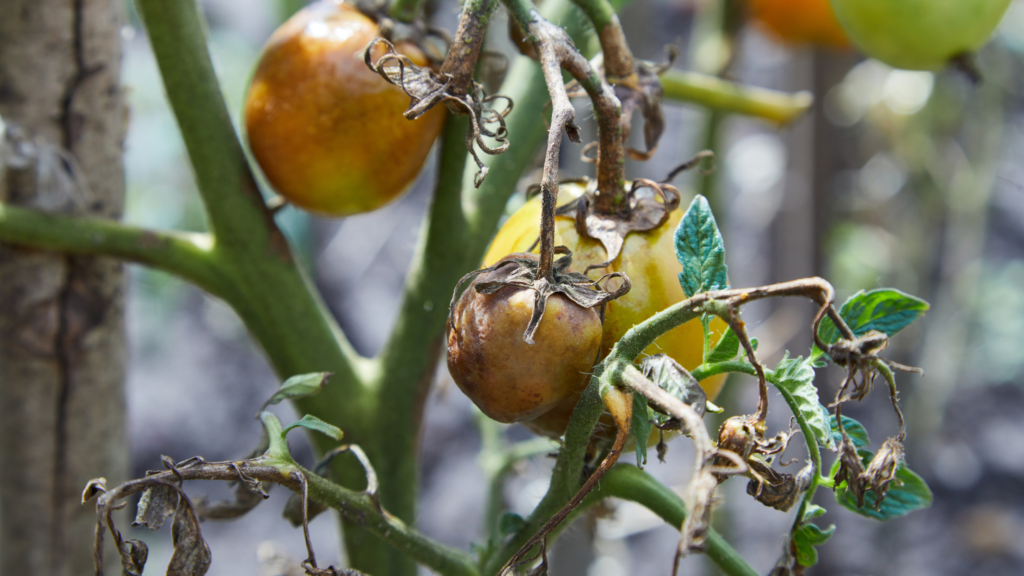
Spores do not die at temperatures below 10 degrees Celsius. Even in severe frosts, they remain alive. You can determine the presence of a plant disease by dark spots that appear on the stems and leaves. Noticeable spots also appear on the inside of the leaves. When the fruits appear, the fungus also spreads to them. This is especially noticeable on potatoes and tomatoes. In addition to the formation of spots, the fruits receive a softer structure at the site of the spread of late blight. This allows the fungus to infect the vegetable more and make it unfit for food. In the absence of processing, products rot.
Some summer residents want to save the harvest and at the same time avoid processing tomatoes from phytophthora in the greenhouse, plucking green fruits so that they ripen on their own. This does not help, as the tomatoes are already infected. They should not be allowed to come into contact with other plants.

How to disinfect a greenhouse from phytophthora
The choice of disinfectant depends on several factors that must be taken into account:
- a variety of plants grown in a greenhouse;
- dimensions of the room;
- weather conditions and temperatures depending on the season.
Treatment of a polycarbonate greenhouse from phytophthora should not be carried out with means that use copper. The substance remains on the fruit, which cannot be allowed. Several folk methods should be included among the main common processing tools.
Water and iodine
Iodine is the main active substance. It is dissolved in water. 10 ml of substance with a concentration of 5% is needed for 10 liters of water. Before starting the treatment, you should pick off the leaves where dark spots are found. Then the fruit and other parts of the tomatoes are sprayed. This operation should be carried out several times with a frequency of three days.
Garlic infusion
To prepare garlic infusion, you need 10 liters of water, 2.5 teaspoons of potassium permanganate and 7.5 cups of finely chopped garlic. You need to heat the water and add all the components.
The solution is infused for 30 minutes. It should be applied to plants by spraying. On average, half a liter of solution is used per plant.
Salt solution
Treatment of tomatoes from phytophthora in the greenhouse can be carried out with the help of salt diluted in water. One glass per 10 liters of liquid is enough for this. The solution is also applied by spraying. When the water dries up, a special film will appear on the plant that protects against the appearance of fungus.
Milk whey or solution
The solution requires 1 liter of milk per 10 liters of water. It is quite simple to mix the ingredients, after which you can spray the tomatoes.
As an analogue, whey or kefir is used. When using serum, the ratio is 1:1.
To increase the effect of exposure, you should add a few grams of iodine.
Bacteria found in fermented milk products fertilize the earth. This prevents the formation of fungus. In these ways, the soil in the greenhouse is treated against phytophthora. Repeated spraying is carried out after half a month.
How to protect plants from phytophthora
Gardeners use the same greenhouses for different crops, and if the previous crop was infected, then before planting a new greenhouse, it is necessary to treat phytophthora. It is advisable to do preventive treatment before planting each new crop.
As preventive measures, you need:
- start mulching the soil (laying a protective layer of material on its surface);
- tying bushes so that they do not touch the ground;
- do not plant very densely, so that when the fungus appears, it does not spread to all plants at once;
- stepsons and extra leaves should be eliminated.
All this will help to get rid of infection with dangerous diseases. Prevention and operative actions at the detection of the first signs of the fungus will save the crop from general infection.