
Beetroot is a biennial plant. In the first year of cultivation, turnips are obtained. In the second season, root crops are planted to obtain seed material. Turnips are used to prepare salads, borscht, and side dishes. Its shape and color depends on the type of culture. Let’s analyze the rules for growing beets in open ground: site preparation, planting order, watering regime, disease prevention. How to get a full-fledged root crop, with good taste characteristics and attractive appearance? What rules must be followed?
Most often, beets with burgundy flesh are grown in garden plots. They contain a high level of anthocyanins and carotene.
How to prepare a bed
Beetroot belongs to crops with a long daylight, so a sunny area is found for it in the garden. To protect the plant from many infectious diseases and insects, crop rotation is taken into account. Beetroot is not grown on the same plot for 2 years in a row.
It is necessary to prepare loose and fertile soil for beets. This is especially important for varieties that have cylindrical turnips. It can deform on heavy soil. On excessively fertile soil, root crops grow numerous lateral processes, a lobe is formed:
- black soils are the most fertile. Growers recommend diluting them with sand or sawdust. Up to 5 kg of sand and sawdust, ½ part of a bucket with a volume of 10 liters are applied per 1 m2. These measures will make the soil easier;
- humus 10 kg/m2, peat up to 5 kg/m2, sawdust are added to the loam;
- beets can be grown on sandstone, but more rotted compost must be added, up to 20 kg/m2;
- clay soil is considered the most unfavorable for the cultivation of vegetables. It is ennobled with humus, peat and sand. Gardeners often build high beds, but no more than 40 cm in height. They are protected by boards; a box is obtained, which is filled with a nutrient and loose soil mixture;
- 1 kg of ash and 20 g of “nitrofoska” are scattered on every 1 m2. This is prevention against fungus, wireworms, and nematodes;
- all work is carried out in autumn, the soil is dug up with 2 shovels;
- in the spring, before weeding the bed, mineral fertilizers are scattered on it, 20 g of urea or ammonium nitrate, 40 g of superphosphate and 20 g of potassium salt.
Sowing beets or planting seedlings is carried out in moist soil. Cow dung or bird droppings are not used. These organic fertilizers are saturated with nitrates. They decompose for a long time. After applying organic matter, any garden crops can be planted on the garden bed only after 2 years.
How to plant
Beetroot is grown by seeds or seedlings. The seed must be prepared, disinfected in a 1% solution of hydrogen peroxide or in a thick solution of potassium permanganate.
You can keep it in melt water. It is a natural biostimulant, “triggers” metabolic processes in the core. It is recommended to dry the seeds before planting.
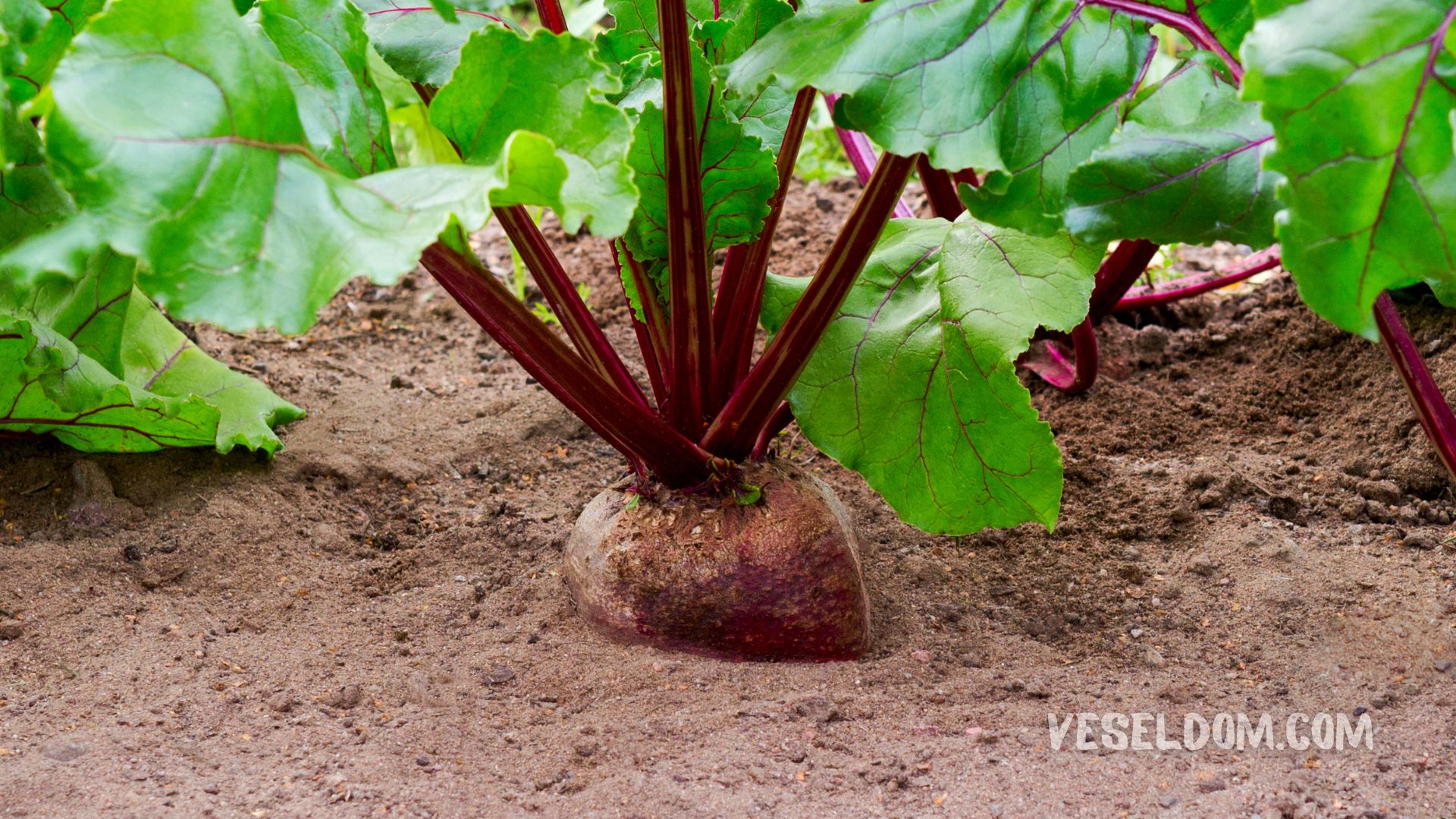
Early beet varieties are sown in April, in mid-May. Mid-ripe crops begin to be grown from the end of May, late varieties are sown in mid-June. When planting plants, gardeners are most often guided by air temperature. Favorable soil temperature is 5-8 oC, air 10-12 oC.
- rows up to 5 cm deep are made on the bed, with a row spacing of up to 20-40 cm;
- if the variety is large-fruited, then the distance between the rows can reach 60 cm;
- sand is laid on the bottom, lightly tamped, sprinkled with ash;
- seeds are planted to a depth of 3 cm in steps of 5 cm. Sprinkle the seedlings with a moist soil mixture;
- cover the bed with a film. It protects seeds from rain and frost. The bed is regularly ventilated;
- seedlings appear after 3-4 weeks. Seedlings that have been treated with a growth stimulant develop after 2 weeks.
To obtain a quick harvest, beets are grown through seedlings. To obtain seedlings, sowing is carried out at home or in a greenhouse. The optimal temperature for the development of seeds is 20 oC, after sowing, the temperature is lowered to 14-16 oC, the light day is 8-10 hours for them.
Beets can suffer from fungal diseases, such as cercosporosis, fomosis. Root crops develop incorrectly in case of bacterial infections, jaundice, and cancer. As a prevention against pathologies, plant growers recommend treating the seed with Bordeaux mixture. Prepare a solution, 1 ml/l, spray the seeds.
Seedlings are sown in early March. Planting seedlings in open ground is organized when the air temperature rises to 12 oC. Before planting a seedling, it must be hardened and adapted to weather conditions. Beet holes are placed at a distance of 15-20 cm.
Thinning
Growing beets in open ground is associated with some difficulties. Plant seeds are not planted in the soil, but fruits. They are a box consisting of fused inflorescences. Each inflorescence develops 1 seed.
In total, there may be 2-3 seeds in a box, so early thinning is necessary when sprouts appear. Otherwise, they will prevent each other from developing.
The first thinning is carried out when 2 full leaves appear on the bush. The soil is moistened. Seedlings are planted, leaving up to 8 cm between them. If the step between seedlings is too large, then root crops can develop with pathology.
The second thinning is designed to withstand a certain density of planting plants. Beets begin to develop tops that shade the soil. The turnip begins to form. She needs more space. Correction is carried out when 4 leaves grow on the bush. Seedlings are planted in a separate bed.
Growing beets from seedlings does not require correction of planting density. Seedlings are immediately planted according to the scheme optimal for the development of root crops.
If winter crops were sown, then thinning is carried out when the air temperature rises to 12-15 oC. In adverse weather conditions, seedlings are covered with a film tunnel.
Irrigation mode
Beetroot loves not only the sun, but also moisture, so when growing it is necessary to follow the watering regime. The frequency of watering and the volume of water depends on the growing season. Always use warm liquid.
To do this, it is recommended to install a container on the site, fill it with water in advance. With cold watering, root crops are deformed:
- seedlings that are under the film do not need to be watered. Sufficient moisture is stored in the bed. You don’t need to take care of them. They are waiting for sprouts to appear.
- when steps appear, the film is removed. The frequency of watering depends on soil moisture. With high humidity, watering is carried out once every 2 weeks. Plants are irrigated from a small watering can. Pour 4-6 liters of water per 1 m2. In arid regions, make 1 approach per week.
- after the second thinning, root irrigation is recommended. Use 8-10 liters of water.
- when the root crop begins to pour, grows intensively, up to 12 liters are needed to moisten 1 m2.
- watering is stopped 3 weeks before the predicted harvest. Beets are left to ripen. The soil is moistened only at low humidity.
Weather conditions are taken into account when growing and caring for plants. If it often rains in the region, then the seedlings are covered with a film tunnel or a mobile greenhouse. This makes it easier to maintain proper watering for root crops.
To preserve soil moisture and prevent the development of fungus on the surface, mulching is carried out. Sawdust, sand or straw are placed around the bushes. The mulch is regularly turned over so that rodents and slugs do not get stuck in it. Watering is carried out on mulch.
The juiciness of the pulp, the level of nutrients and sugar depends on the quality of beet watering. When the soil is too intensively moistened, vitamins, mineral salts and sugar are washed out of the root crop. The pulp becomes juicy, but fresh. With a lack of moisture, the root crop does not accumulate a normal level of nutrients, it becomes fibrous. When growing, you need to follow the soil moisture regime.
If there is no mulch, it is necessary to loosen regularly; destroy the dry earthen crust. It prevents air from reaching the roots.
Up to the moment when the turnips did not come out of the ground, they are turned over. When the root crop increases in size and appears on the surface of the garden bed, weeding is stopped.
Feeding
It is recommended to follow the rules of cultivation and care in open ground for beets. It must be taken into account that during the development of the leaf rosette, the plant needs nitrates. When rape begins to develop, the plant needs phosphates and potassium.
During the ripening period, it is necessary to saturate the soil with boron, magnesium, iron, and manganese. These features must be taken into account in the agrotechnics of crop cultivation, when introducing top dressing.
It should always be remembered that only mineral fertilizers and complex vitamin and mineral preparations are used as top dressing. They are administered only as indicated. Indiscriminate use of top dressing will disrupt the development of the root crop, provoke the formation of the lobe, deformation of the turnip.
If the soil is well prepared, then mineral fertilizers are not used. It is allowed to introduce drugs after treating plants with chemicals against infectious diseases and insects.
Gardeners aim to increase immunity in plants. How to grow sweet and tasty beets? According to what scheme top-feeding is introduced:
- 2 weeks after the first thinning, nitrogen fertilizers are introduced, 20 g of ammonium nitrate or urea is diluted in 10 liters of water. At a distance of 5 cm from the root crop, a bed is made into which top dressing is introduced. 20-50 ml for each plant;
- 2 weeks after the second thinning, 20 g of potassium salt and 40 g of superphosphate are introduced;
- during the period of beet growth, it is recommended to add table salt to the irrigation water, 2 tbsp. l. for 10 liters Correct introduction of feeding and care will ensure the concentration of sucrose in the pulp;
- before the ripening period, boric acid is introduced: 5 g per 10 l, 50 ml for each bush.
To increase the yield of root crops, use “Kristalon” preparations with white, red or yellow crystals. Dilute the drug 20 g in 10 l. The liquid is added when watering, 1 l / 10 l. Use “Zdraven”, 15 g / 10 l; spray the bush until the leaves and soil are completely moistened.

Preventive measures
Caring for beets requires constant inspection of plant leaves. Normally, they should be green with burgundy veins.
If plaque appears on the plate, this should alert the gardener. Plaque appears with ordinary or false powdery mildew. This is a fungal disease.
Mycelium spreads at high humidity. This leads to the death of plants. As a preventive measure, the drug “Aktara” is used, 1 ampoule per 10 liters. Leaves and soil are sprayed.
If brown spots with clear borders appear on the leaves, the edges are burgundy, this is cercosporosis. Rotten spots appear on the stems.
For this disease, Bordeaux mixture is used, 10 ml / 10 l. This drug is used for mosaic, fomosis; yellow spots appear on the leaves with the manifestation of rot in the core.
The plant attracts a beet weevil, a fly, and aphids, so the care of garden crops in open ground involves the use of insecticides. “Nitrophoski”, 10 g/l, Decis, 1 g/l are used as prevention.
Bushes and soil are sprayed. As a folk remedy, an infusion of needles, an ash solution with the addition of tobacco dust or red pepper is used.
When growing beets, it is necessary to follow agrotechnical rules. They boil down to timely watering, feeding, weeding and loosening the soil.
Fungicides and insecticides are used to prevent diseases. Many difficulties can be avoided if the soil and seeds are well prepared for sowing.