
Most people associate rabbits mainly with an animal source of meat or skins. However, these unusual animals should be considered as a broader concept that is not limited to the use of their resources. Rabbits are interesting and fun pets that cannot be compared to other animals found in the household. Taking the breeding and keeping of rabbits at home lightly is a wrong approach. They need constant care, as well as proper conditions and proper nutrition.
In this article, we will look at different ways of keeping rabbits in a private household, which will provide them with comfortable conditions and make their lives happy. You will learn about important aspects such as taking care of their health, proper nutrition and creating normal environmental conditions that will ensure a happy and contented existence in their home environment.
Room for keeping rabbits
The premises for keeping rabbits is of great importance to ensure their comfort and health. In modern times, there are various types of housing that can be used for rabbits in the home conditions of a private farm. Let’s consider some of them:
- Shed (shed). It is a structure made of wood and metal, where cages for rabbits act as walls. In certain cases, suspended structures can be used, which simplify feeding and provide convenience in caring for animals.
- Rabbit breeder It is a building using building materials such as wood, brick or concrete, which is built without gaps and is well protected from drafts.
- Cages These are structures made of metal and wood, in which rabbits are kept individually or in small groups (especially young ones). The number of rabbits in a group depends on their purpose. It is recommended to keep the main stock and older rabbits separately: one male in a cage with a floor area of 0.5-0.7 square meters, and two females older than 3.5 months. Up to six to eight baby rabbits weighing 1.5-2.0 kg can be kept together in large cages with a floor area of 0.25-0.3 square meters per rabbit.

- Aviaries. This is part of the homestead, which is fenced off and allows the rabbits to roam free. Aviaries can be used as an independent form of maintenance or in combination with other types of premises.
The choice of housing type depends on various factors, such as available resources, the number of rabbits, the experience and capabilities of the keeper. Regardless of the chosen option, it is important to follow the rules and regulations for keeping rabbits in order to provide them with comfortable living conditions.
Light day and sanitary and hygienic norms
Daylight and compliance with sanitary and hygienic norms are of great importance for the health and well-being of rabbits. Correct lighting and microclimate help to ensure the normal function of the animal’s body.
One of the important aspects is the length of daylight. Rabbits need a sufficient amount of light, especially during periods when the natural light day is shortened, as is the case in winter or when rabbits are kept indoors. It is recommended to provide rabbits with a light day lasting at least 16-18 hours.
Lighting also plays an important role. Different categories of rabbits may require different levels of lighting. Male producers need more light – from 100 to 125 Lux, rabbits with rabbits also need light – from 40 to 70 Lux, and young animals need about 20 Lux.
In the summer, rabbits need sunlight to saturate with vitamin D, but when kept outside, it is recommended to protect the cages from direct sunlight to avoid overheating of the animals. If rabbits are kept indoors, the windows should be placed so that sunlight from the outside penetrates.
An important aspect is also the area of windows in the room for keeping rabbits. It is recommended that the window area should be approximately 10% of the floor area of this room. In the case of the winter period, when there is not enough natural light, artificial lamps can be used to ensure sufficient lighting in rabbit hutches.
Adherence to daylight and sanitary and hygienic norms are important factors for the successful keeping of rabbits at home. They provide optimal conditions for the health and comfort of animals, which contributes to their proper growth and reproduction.
Temperature and humidity regime
The temperature and humidity regime in the room where rabbits are kept is of great importance for their health and comfort. Optimal air temperature indicators are in the range between +10°С and +20°С. Air humidity should be within 60-80%.
It is important to control the speed of air movement at the level of the animals, which should not exceed 0.3 m/s. The air in the room should be clean, ammonia should not be more than 0.026%, and the carbon dioxide content should be up to 0.5%.
High humidity and temperature can cause rabbits to overheat, while low temperature and high humidity can lead to chills and colds. Drafts and strong winds can also be harmful to rabbits, contributing to illnesses, including colds.
Therefore, it is important to provide suitable conditions in the room, observing optimal indicators of temperature, humidity and air movement, which will contribute to the health and well-being of your rabbits.
Keeping rabbits in cages
Keeping rabbits in cages is an old and proven method that provides convenience in animal care. However, it is important to follow some recommendations of experienced rabbit breeders.
When building cages for rabbits, it is recommended to use wooden parts with a thickness of at least 15-20 millimeters to avoid gnawing with the sharp teeth of animals. Upholstery of the inner part of wooden walls with mesh, galvanized iron or metal profile is the best option. For the construction of cages, it is desirable to use hard species of trees, such as oak or maple.
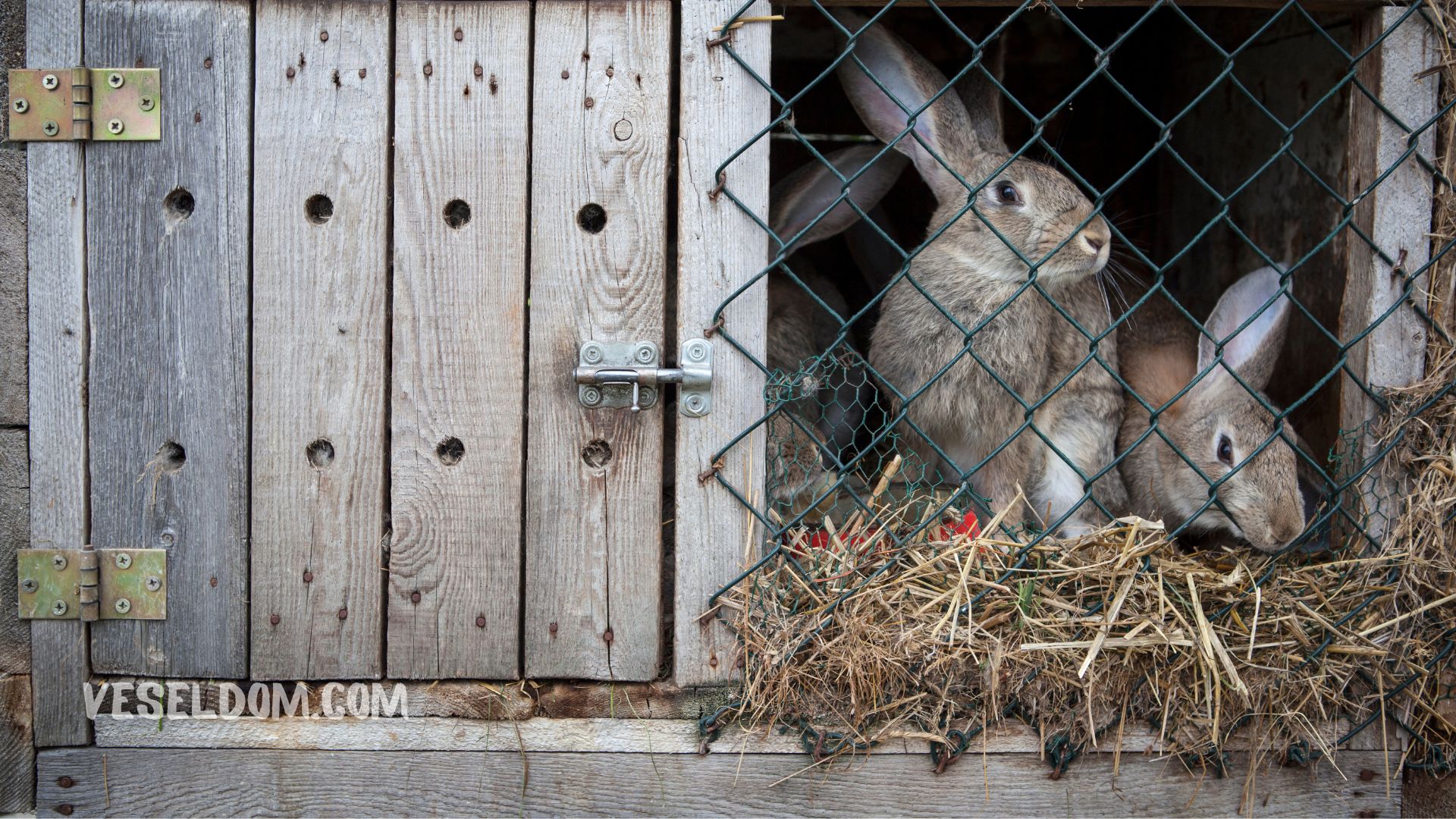
Special attention should be paid to the arrangement of the floor. To facilitate the waste collection process, it is recommended to use a slatted or mesh floor in all parts of the cage, with the exception of the nest with the rabbits. If the cages are located on several levels, then the floors of the upper cages should be two-level to avoid feces and urine entering the lower row of cages. To prevent problems with the health of the paws, some parts of the cage may have a solid floor or an insert floor.
To protect the rabbits from the weather, a removable glazed frame can be installed, which can easily be pushed aside in clear, windless weather to allow access to fresh air and sunlight. In regions with warm winters, where it is possible to keep rabbits outside, cages can be fenced with shields or covered with film, and an additional gable roof can be installed. However, in cold winters it is better to move rabbits to a warmed and plastered room.
Keeping rabbits in cages has its advantages. The rationed giving of fodder allows you to avoid overspending. In addition, it eliminates uncontrolled mating, makes it possible to isolate a sick animal from others, facilitates the process of catching animals and helps to obtain more tender meat at slaughter. Also, the time of fattening animals is reduced due to limited motor activity and their mutual beating is prevented, which allows to preserve the quality of skins.
Despite these advantages, keeping rabbits in cages has negative aspects. Requires a lot of time for feeding and cleaning cages, as well as constant disinfection to ensure hygiene and prevent disease.
How to properly keep rabbits in cages: quarantine
After acquiring new animals, it is important to follow the quarantine procedure before settling them on the territory of the farm. Quarantine involves keeping animals in temporary isolated homes, where strict control and health monitoring is carried out. It also helps animals to get used to new living conditions, host, food and regime.
The main requirements for the quarantine department include:
- A separate room or isolated cages.
- The length of stay of rabbits in quarantine is from 29 to 36 days.
- Use of separate overalls for staff, separate equipment and fodder.
- Enters the quarantine department using a disinfecting mat.
During the quarantine period, rabbits are carefully examined daily, including the nose, ears, skin and genitals. They also measure their body temperature and observe their activity, appetite, and the nature of their bowel movements. Mandatory procedures during quarantine are deworming, treatment for fleas and lice, and, if necessary, claw trimming. Animals are also accustomed to a new type of food.
During quarantine, it is recommended to donate blood for analysis to detect possible hidden pathological conditions.
At the end of the quarantine period, if no signs of disease are observed, the rabbits can be transferred to the main premises, and the quarantine is considered complete.
Shady
Shed frame structures for keeping rabbits are becoming more and more popular because they have many advantages compared to other types of housing.
Advantages of shed maintenance:
- Simplicity and ergonomics.
- The possibility of independent construction even for an inexperienced breeder.
- Low construction costs.
- Convenient access for pet care.
- Lots of free space for rabbits to move around.
- Access to fresh air.
- Reducing the risk of diseases.
- Ensuring optimal hygienic conditions for animals.
Disadvantages of sheds:
- They need insulation in the cold season.
- In frost, food freezes in feeders and water in drinking troughs.
As you can see, rabbits feel most comfortable in sheds. But the disadvantages are easy to eliminate, for example, by installing closed variations of sheds (especially for regions with cold winters) or using automatic heating systems for drinking bowls and feeders. By overcoming these minor shortcomings, you can ensure maximum comfort for animals.
Floor keeping of rabbits
Rabbits, by nature, are very active mammals. They need free movement for their normal growth and development. The limited space of the cages cannot provide them with such freedom, which makes raising rabbits “in the wild” a more attractive option.
Some farmers successfully raise rabbits simply on the floor of indoor facilities or in open enclosures such as aviaries, without using cages or other types of housing. They note that this method significantly reduces the time spent on maintenance, and also promotes more active movement and growth of the animals.
Floor housing for rabbits has its advantages:
- Free movement: Rabbits can freely move, jump and explore their environment, which promotes their physical development and psychological well-being.
- Reduced maintenance time: The absence of cages reduces the need for cleaning and maintenance. Farmers need to spend less time setting up, cleaning and repairing cages.
- Stimulation of activity: Rabbits kept on the floor or in enclosures have more opportunities for movement, which helps to maintain their activity and muscle tone.
- Natural conditions: Eared animals can become more attached to natural conditions, such as different floor textures, interacting with the soil and receiving natural light.
The following factors must be taken into account:
- Hygiene: It is important to ensure the cleanliness of the premises and the garbage disposal system to avoid health and odor problems.
- Ensuring safety: The floor or bedding must be safe to avoid injury to the animals.
- Insulation: In the cold season, it is necessary to provide sufficient insulation to prevent hypothermia of rabbits.
Floor housing for rabbits can be an effective option for farmers who want to provide more natural conditions for their animals and simplify the keeping process. Considering the hygiene, safety and comfort of rabbits, this method can be a profitable choice for breeding eared rabbits.
Aviary keeping of rabbits
Keeping rabbits in an aviary is one of the options for free-range breeding of these animals and can be successful for novice breeders working at home.
Basic recommendations for the organization of enclosures for rabbits:
- Site selection: It is recommended to choose an elevated site to avoid flooding.
- Wall material: The walls of the enclosure can be made of various building materials, such as wood, corrugated board, ondulin or slate.
- Use of mesh: Part of the fence can be made of mesh to allow sunlight and ventilation.
- Floor type: The floor of the enclosure can be earth, concrete, mesh or slatted.
- Shade and shelter: It is important to provide a part of the area with a canopy or a small shed where the rabbits can hide from rain or direct sunlight.
- Queen hives: Installing small houses in the aviary will help solve the problem of queen hives and provide a convenient place for the birth of young.
Some advantages of keeping rabbits in an aviary:
- Free range: Rabbits have the opportunity to walk and move freely, which has a positive effect on their physical development.
- Feeding: Rabbits can get enough milk because each lactating rabbit feeds all the young.
- Cost-effectiveness: Aviary keeping can be cost-effective, especially for domestic conditions, as it does not require complex building structures.
- Convenient care: Rabbit care in enclosures can be easier and less time consuming compared to other housing methods.
- Improved appetite: Rabbits kept in enclosures have a larger appetite and grow better.
- Convenience for busy people: Keeping an aviary can be an ideal option for people who do not have enough time to care for animals on a daily basis.

However, aviary maintenance also has its disadvantages:
- Tough meat: Cage keeping can lead to tough meat of rabbits.
- Morbidity and decline of stock: Mass mortality and morbidity of animals can be a problem in aviary keeping.
- Wintering: In the cold period of the year, it is necessary to move rabbits to warm premises or send them to slaughter.
- Unsanitary conditions: There is a risk of keeping animals in unsanitary conditions if adequate hygiene is not ensured.
- Use of feed stocks: Aviary housing can lead to increased use of feed stocks.
- Fighting and incest: Fighting between rabbits can lead to injuries and uncontrolled incest.
- Irrational use of the territory: Aviary maintenance can be inefficient in terms of the use of the territory of the homestead.
If sawdust is used for bedding, the collected compost can be a valuable fertilizer for the garden.
Recently, many breeders abandon the floor type of keeping rabbits, regardless of the type of covering, because this method is often accompanied by disadvantages.
Keeping rabbits in a free environment
Recently developed breeds of rabbits, in addition to improved characteristics, turned out to be particularly sensitive to the influence of external factors. Some rabbit breeders believe that providing freedom and the opportunity to freely spend time can contribute to the restoration of the former endurance of animals.
It has been observed that when rabbits get into their natural environment, they grow better, mate more often and strengthen their weakened immunity. In addition, for breeders, keeping “free” animals can be a more economical and interesting approach.
Keeping rabbits in pits
A pit is one of the options for “free” housing for rabbits. Some gourmets note that the meat of rabbits living in pits is particularly tender and has a unique taste.
This type of housing is suitable for such breeds of rabbits as California, Burgundy, New Zealand, as well as Rex, Gray Giant, Soviet Chinchilla, as well as domestic non-bred rabbits that have endurance.
Each owner digs a hole at his own discretion, since there are no clear recommendations or drawings. The pit is covered with a roof or a superstructure is made, for example, a shed. It is also necessary to maintain an optimal temperature and ensure adequate air ventilation. To prevent digging holes, the walls of the pit can be covered with slate or cemented.
The floor can be left bare or covered with slats, mesh or plywood for greater practicality. It is also advisable to leave a place for further expansion of the space by excavation, so that the rabbit has the opportunity to equip nests in the ground.
After the pit is ready, a male and several rabbits are placed there. Next, you need to periodically clean and feed the animals. One pit structure can accommodate up to 200 rabbits. Some unclaimed basements or cellars can also be used for this type of storage.
However, there are some limitations to the use of the pit method of containment, if the selected site is not suitable for digging due to a high level of groundwater or a very harsh climate with deep freezing of the soil in winter.
Positive aspects of holding in pits:
- A minimum set of building materials and inventory.
- Fast construction.
- No drafts.
- Durability of the building.
- Saving space.
- Easy care, occasionally, compared to cages.
- Rapid reproduction.
- The immunity of rabbits improves.
- Rabbits become more independent, show protective reactions in relation to other animals.
- Maternal instincts in females improve.
Disadvantages of keeping in pits:
- Inability to control the process of mating and birth of offspring.
- Inability to carry out disinfection.
- There is a great risk of dangerous diseases that can cause the death of livestock.
- Complications with litter collection.
- Frequent injuries of males due to constant fights.
Rabbits living in pits become wild and aggressive and are often difficult to catch. To teach animals to come at the sound of a whistle or the flashing of a flashlight, you can feed them. When rabbits gather, they can be caught with a net.
Maintenance on grazing
Care for rabbits that graze freely on the plot is reduced to a minimum. Usually, the grazing area is divided into three parts: one is used for grazing, the other is where the sown grass grows, and the third is only being sown at this time. Thus, uninterrupted power supply is ensured.
If a meadow is adjacent to the site, it can also be used by periodically applying fertilizers and planting the necessary plants there. Oats, field crops, timothy, and leguminous plants (clover, vetch, alfalfa) are used for sowing. You can also add wormwood, dandelion, tansy, plantain, cuff, and Ivan-tea seeds when sowing.
The territory of the pasture is lined with shrubs (for example, verboloza), which will perform the role of a fence, and the rabbits will run along their branches, grinding their teeth. Pasture can be organized even in the garden, but in this case the crown of fruit trees should be protected so that eared animals do not harm them. So that the eared animals do not have stomach problems, and the grass is well digested, hay is periodically scattered on the feeders.

The hayloft, feeders, and drinkers should be placed under a canopy that will protect the animals from rain and strong wind. Under the shelter, animals will be able not only to rest and hide from the weather, but also to reproduce. You can dig holes or install artificial boxes buried in the ground on the pasture. Rabbits will definitely like such places, and they will love to rest there.
It is interesting that it is in such burrows that females willingly nest and give birth to offspring, and then safely leave the newborns, going to the pasture to feed. Minks can be made of stone, boards or brush. The inconvenience is that rabbits cannot graze freely all year round, and they will still have to be taken off the street for the winter.
The number of holes in the pasture should exceed the number of livestock. Every rabbit has the right to its own cozy corner!
Street keeping of rabbits
Experts are very sympathetic to the street keeping of rabbits, although this method of rearing has both positive aspects and negative feedback from practicing animal breeders.
Advantages of street maintenance:
- Liquid cleaning.
- No ventilation required.
- No fume hood required for ammonia.
- No heating required.
- Rabbits become hardened in the fresh air and get sick less.
- In the cold season, it is financially more profitable, since the creation of winter cages and brood boxes is cheaper than the construction of a full-fledged barn, and they are easier to make with your own hands.
Disadvantages of street maintenance:
- Problems with nutrition (water freezes in drinking bowls, food freezes in feeders).
- Queens need additional heating.
- Diseases are quickly transmitted, which can lead to a massive fall in livestock.
- The meat may be of lower quality.
- There is a risk of animals escaping.
- Purebred rabbits cannot be bred successfully.
Regardless of the chosen method of maintenance, it is important not to forget about such important aspects as living conditions and rational nutrition. Only by observing all the precautions and recommendations of specialists, you can get a healthy breed of rabbits.