
A greenhouse helps to protect seedlings from frost and to harvest earlier than in open ground. The peculiarity of closed soil is in the microclimate, high humidity and temperature. This contributes to the rapid reproduction of fungal diseases, so the greenhouse needs careful care. In autumn, after harvesting, work is carried out to remove plant residues and disinfection. And what to do with the greenhouse in the spring? As soon as the temperature is above 0 °C, you need to start preparing the room for the soil for sowing. Let’s analyze how and with what to treat the greenhouse in the spring from diseases and pests. We perform the work in stages.
Cleaning
We start preparing the greenhouse in the spring with internal cleaning:
- We take out boxes for seedlings, pegs, inventory.
- We remove and burn the dry remains of weeds.
- We cut off the old garter and destroy it.
- We inspect metal structures, clean them from rust, prime and paint them.
- We check the integrity of the polycarbonate, if there is any damage, we repair it.
- We clean the paths between the beds.
Fight against dirt and dust
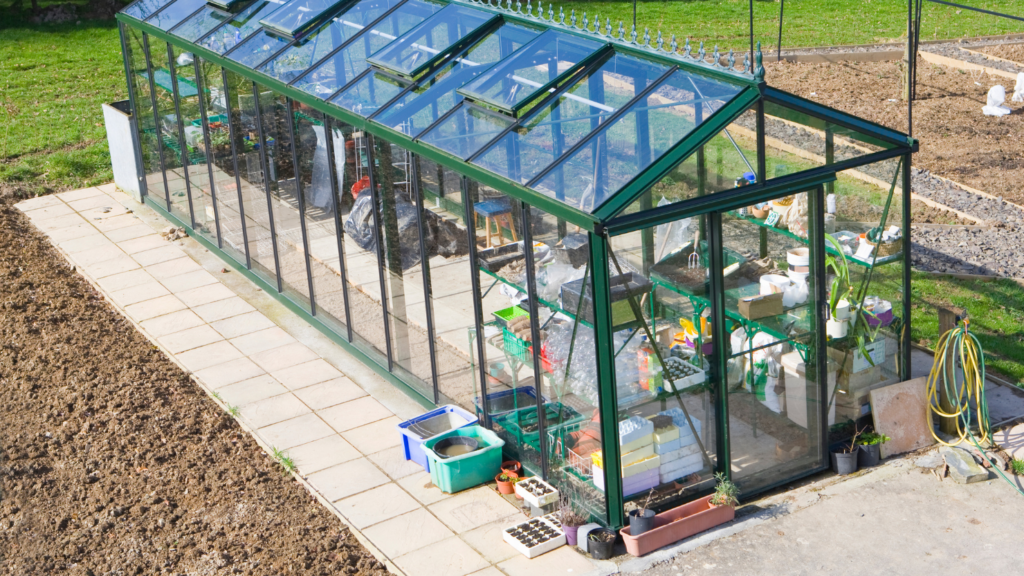
When the inside is in order, we start cleaning the polycarbonate. Due to dust and dirt, 30-50% of sunlight is blocked. My greenhouse is in dry warm weather, at t + 5 + 10 ° C. Outside, polycarbonate can be washed with any detergent, cleaning with a brush and washing with water under pressure.
For washing inside you can use:
- A solution of household soap. We wash the polycarbonate with a sponge or a brush for windows. We clean all structures, wash them.
- Synthetic detergents. Chemical detergents are removed with a cloth, and not washed off with water. Otherwise, the chemicals will get into the ground and adversely affect the seedlings.
- Mustard. You can dip a wet sponge in mustard powder and rub the walls of the greenhouse. Mustard cleans pollution well and does not harm the earth, so you can safely wash it off.
- Ammonia solution: 1 tbsp. spoon per 10 liters of water.
After washing, we leave the doors and windows open until all structures are dry.
Greenhouse disinfection
It is possible to disinfect the greenhouse in the spring by chemical and biological methods. Disinfection is carried out in autumn in preparation for winter, but many pests and bacteria tolerate low temperatures and survive in the soil layer. Therefore, we process the greenhouse in the spring in full.
Chemical methods are effective, act quickly, but they harm the microflora.
- Chlorine lime: destroys pathogens of bacterial diseases, pathogenic fungi. Method of preparation: dilute 400 g of chlorinated lime in 10 liters of water, insist for 4 hours, pour into a garden sprayer. Process the greenhouse, close and leave for 2 days. Then ventilate. Precautions: gloves, respirator, glasses.
- Copper sulfate protects against late blight, gray rot, powdery mildew, and scab. Method of preparation: dissolve 50 g of copper sulphate in warm water, then add to 10 l. The effect of the drug begins after 1 hour and lasts up to 14 days.
- Fumigation with a sulfur checker: destroys bacterial infections, mold, fungi, insect pests. How to use: a checker of 500 g is designed for 10 m3. Close the doors and windows in the greenhouse. Install the checkerboard on a metal sheet at a distance of 0.5 m from combustible structures. Precautions: set fire to the checker in pairs, one inside the greenhouse in personal protective equipment, the other supervises outside. Immediately leave the greenhouse after the wick catches fire. Open the door and ventilate after 2-5 days. Work to be done in 2 weeks.
Cons – sulfuric anhydride gets into the soil, and then into the plants; destroys metal structures; slightly helps against late blight, false powdery mildew.
Biological methods work slowly, are less effective, but they do not harm the environment.
- Decoction of pine needles: pour half a bucket of pine branches with water, boil for 20 minutes, pour the soil over them, wash the walls.
- Garlic tincture: pour 40 g of crushed garlic into 10 liters of water, insist for a day. Wash all structures, polycarbonate.
- Tincture of nettles: pour half a bucket of dry nettles with boiling water, leave to infuse until completely cool, filter and wipe the greenhouse inside.
- Pharmaceutical pine extract: dilute 200 g in a bucket of cold water, wipe structures and polycarbonate.
Disinfection of the greenhouse in the spring is a mandatory measure. If you neglect them, you will have to fight with plant diseases all summer.
Soil disinfection in the greenhouse
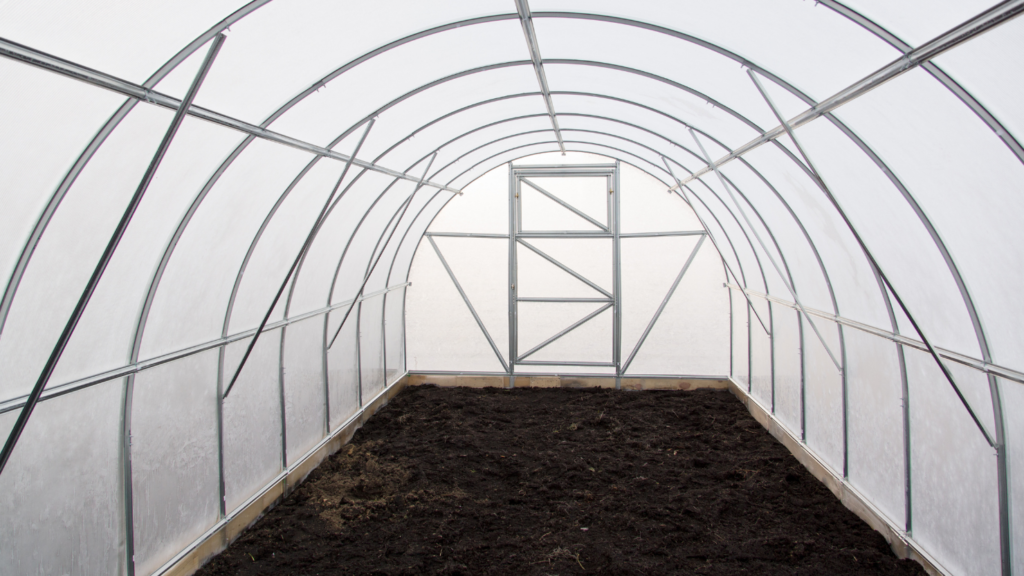
How to prepare a greenhouse for planting in the spring? In addition to processing polycarbonate and structures, it is necessary to disinfect the soil. The fertile layer is depleted, pests hibernate in the soil. The solution is to replace 20 cm of the top layer of the earth. The process is time-consuming, it is carried out once every 3-4 years. And every spring, the soil must be disinfected:
Thermal method :
- watering with boiling water. 1-1.5 months before planting seedlings, pour boiling water over the beds – 3 buckets per 1m2 and cover with a film. Minus – beneficial microflora dies.
Chemical method:
- A 1% solution of potassium permanganate destroys hibernating insects. 2 weeks before planting seedlings, pour the soil, cover with a film. Minus – manganese solution acidifies the soil.
- Bordeaux liquid is effective against false powdery mildew. Dissolve 100 g of copper sulfate in 1 liter of hot water, add up to 5 liters. Separately, dissolve 120 g of lime in 1 liter of water and dilute to 5 liters. Pour copper sulfate into the lime solution, mix. Protective properties are preserved for 1 month.
Biological method :
- preparations based on bacteria and the fungus Trichoderma are effective for the prevention of various diseases and do not disturb the microflora of the soil. Biopreparations: Fitosporin-M, Fitop-Flora-C, Fitoverm, Fitolavin.
Minus – they are effective for a short time and not against all pathogens, treatment of the greenhouse against diseases and pests must be repeated during the season. Apply according to the instructions on the packages.

Fertilizer for soil in spring
Disinfection of the greenhouse in the spring with chemical preparations or boiling water leads to the death of beneficial microorganisms. Fertilizers and trace elements are necessary for plants. You can fill them in several ways:
Organic fertilizers : easily assimilated by plants, environmentally safe.
- Manure – rotted cow or horse manure is used.
- Compost is prepared for 6-12 months. We put leaves, tops, cleaning in a box, sprinkle with superphosphate, water with water, cover on top and leave to ripen for six months.
- Humus – rotten leaves, grass.
- Peat.
Mineral fertilizers:
- Phosphorus – superphosphate ensures active growth of plants, applied during digging in the form of a solution according to the instructions.
- Potassium – potassium sulfate, nitrophoska.
- Nitric – ammonium nitrate (used only for neutral and alkaline soils), urea (urea), potassium and sodium nitrate, ash.
The dosage of mineral fertilizers for each crop is different and indicated on the packages.
A simple way to restore soil fertility and disinfect it is to plant siderats. They quickly increase the green mass and root system. Before flowering, the plants are mowed or dug up. The soil is enriched with nitrogen, the roots disinfect the soil, destroy bacteria, get rid of wireworms and nematodes. This is an environmentally friendly way to increase yield, save plants from diseases and pests.
During the preparation of the greenhouse, siderata are planted in the spring:
- White mustard is an unpretentious siderat, sprouts at a temperature of + 3 °C, is not afraid of frost, sprouts are friendly for 3-4 days. Put in the soil after 30 days, but it can be grown together with the crop. A hole is made for planting, and mustard is left around. As it grows, it is cut and placed around the seedlings. This is both fertilizer and mulch. The composition of the green mass includes phytoncides that prevent phytophthora, and essential oils repel harmful insects.
- Phacelia protects against late blight, root rot. Saturates the earth with nitrogen, potassium, phosphorus.
- Rye is frost-resistant, sprouts in 10-12 days. A good precursor for all vegetable crops.
- The vetch is rich in nitrogen, grows quickly, and can be mowed 3 times during the summer. Like mustard, veki can be grown together with vegetable crops.
Siderates are popular among gardeners. They disinfect the greenhouse in the spring before planting seedlings, repel pests, suppress the growth of weeds, and 3 kg of green mass replaces 1-1.5 kg of manure.
How to prepare a greenhouse in the spring, what tools to use, how to prepare the soil and what to fertilize it with – everyone chooses for himself. But it is necessary to remember that it is easier to prevent diseases than to fight them all summer.