
The rich color and density of the lawn cover largely depend on regular and high-quality watering of the lawn. Therefore, special attention should be paid to this process, observing the best time for the procedure and correctly regulating the flow of irrigation fluid. Let’s consider in more detail how to properly water the lawn.
How to understand that the lawn requires watering
- Condition, appearance of the grass.
- Elasticity of grass.
Overwetting the lawn is just as inappropriate as drying it out. Therefore, it is important to find the ideal moment for watering. Different types of grass plants may require different amounts of moisture, so be sure to consider the characteristics of each type. For example, thin legs do not need frequent watering, as overwatering can lead to the spread of mold and pathogens. Assess the condition of the grass: if you notice that the blades of grass turn yellow, wither and begin to dry at the tips, this is a sign that immediate watering is needed, otherwise the lawn may lose its decorativeness.

Another indicator of a lack of moisture in the soil is a decrease in the elasticity of the grass. Juicy blades of grass, saturated with moisture, recover their shape much faster after compression, unlike overdried specimens. If about 30% of the lawn looks moldy after being stepped on, that’s a definite signal to water. The same goes for a lawn that has cracked ground beneath the grass.
What is the best time to water
After determining the need to water the lawn, it is important to consider the time of day when this procedure will be most effective.
During hot summer days, when the water droplets on the grass leaves can act as lenses that attract the sun’s rays, the best choice is to avoid watering, as this can burn the lawn and reduce its decorative qualities.
On the other hand, evening watering is also not always the best option, because after the heat of the day the air temperature drops quickly, and the moisture that got on the grass blades does not have time to dry, which increases the likelihood of fungal lawn diseases.
For these reasons, the most optimal time for watering the lawn is considered to be the morning hours, from 6 to 9 in the morning . During this period, the soil remains moist, and the grass has the opportunity to dry until the middle of the day, when the sun burns the most.
It is important to remember! The ideal liquid for watering is rainwater, collected with the help of a drainage system in separate containers after rainfall. If you have a lake or river nearby, you can use their water, but it is better to avoid using water from a well, as the low temperature and high hardness of the water can adversely affect the condition of your lawn.
How often should you water?
In addition to external signs of the need for irrigation, there are also other recommendations regarding the frequency and regularity of this procedure.
In regions with limited natural rainfall or during periods of limited rainfall, it is recommended to water the lawn at least once every 10 days. However, with high air temperatures for several days (above +30…+35 °C), the interval between waterings can be reduced to once every 3-5 days.
Watering should be sufficiently voluminous, but not so that puddles of water form on the surface of the lawn.
If the grass was sown recently and has not had a chance to develop a hardy root system, it will need to be watered a little more often. If this option is not available, it is better to consider purchasing a ready-made rolled lawn, grown by professionals, since it requires less watering.
In all other cases, during watering through drainage, at least 4-5 liters of liquid per 1 m² should be used, otherwise young and tender shoots of grass can quickly die. The surface of the soil in the first months after sowing should always remain slightly moist so that the roots can penetrate deep into the soil and ensure the strength and endurance of the lawn in the future.
Did you know? Lawns with short grass became popular in Europe already in the 18th century and were considered a sign of luxury. Grass was sown in the territories around buildings and settlements, where the construction of certain objects was planned.
The frequency of lawn watering largely depends on the type of soil on which it grows. So, grass on sandy soils is recommended to be watered once every 1-2 days, on sandy loam – once every 2 days, on loam – once every 2-4 days, and on heavy loam – once every 3 days or once a week.
By following these rules, your lawn will always look good, no matter what grass seed you decide to plant in your area.
Watering rate for different soils
On average, 5 to 15 liters of water is usually consumed per 1 m² of lawn covering. However, it is important to be focused on the general condition of the soil and the amount of natural precipitation that has fallen over a certain period of time. By using absorbents, such as hydrogel, which retain moisture in the soil, the recommended amount of water can be reduced. However, by installing an irrigation system with fine-drop sprayers, you can completely abandon the use of absorbents.
The composition and type of soil in a particular area also affects water absorption and moisture retention, and this can significantly change watering rates. For example, watering a lawn growing on loam can require about 20-25 liters of water per 1 m², but the regularity of watering can be reduced to 1-2 times a week, even in summer. In contrast, if the grass is sown on sand, watering may be needed much more often (sometimes several times a day), while the amount of liquid used will be less, about 5-10 liters per 1 m². Sand, unlike clay, does not hold water, and the roots of the lawn quickly absorb moisture, which is also worth considering when determining the amount of watering.
Methods
When watering the lawn, it is very important to properly distribute the water in the soil to avoid puddles on the surface and submergence of the plant’s root system. This desired effect can be achieved using two main methods: sprinkling and drip irrigation. Each of these options has its own characteristics.
Sprinkling
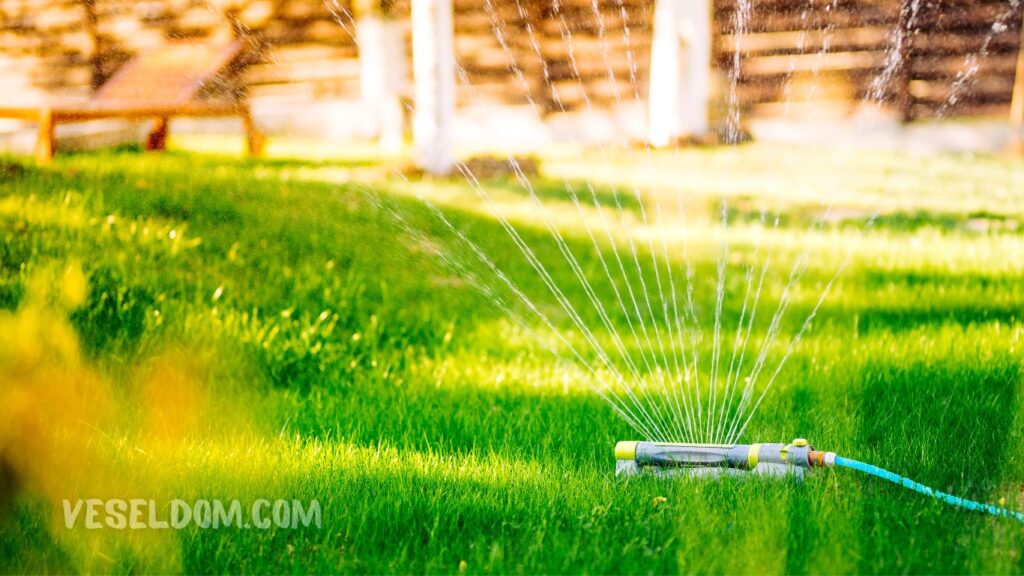
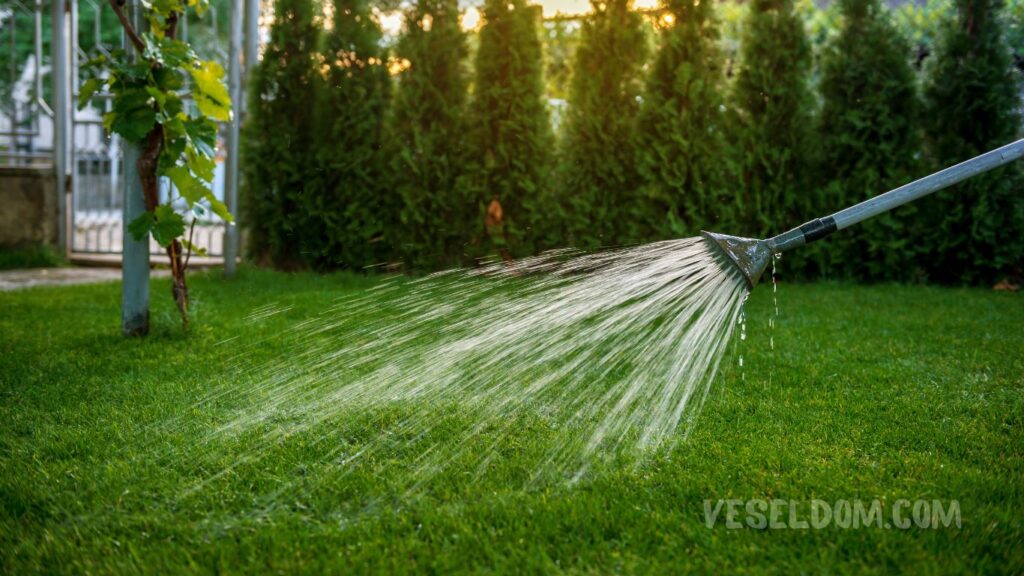
Sprinkling is a manual or automatic spraying of water from a hose that simulates natural raindrops. For small lawns in front of the house, a watering can can be quite effective, but for large areas it is better to install an automatic irrigation system. Some modern models are equipped with turn-on sensors, so you don’t have to get up early in the morning to turn on the watering.
There are many types of raincoats, but basically all possible products can be divided into stationary and portable. With high water pressure in the system, it can be useful to install retractable sprinklers, which mostly remain hidden in the grass and are extended only during watering. Of course, their installation requires the pre-installation of pipes and nozzles, but you do not need to dismantle them while mowing the lawn.
Drip irrigation
Drip irrigation beats sprinkling thanks to the possibility of using it during the day without the risk of changing the appearance of the grass. In this method, water is fed through small holes in hoses scattered across the lawn and directly hydrates the root system, leaving the leaves dry. This method allows you to reduce water consumption, reduce the cost of lawn care compared to traditional sprinkling. To ensure high-quality moistening of the entire area of the lawn, it is important to place the hoses evenly and try to cover as much territory as possible.
Irrigation tools and systems
Among the popular systems and means of irrigation for lawns, the following types of sprinklers are distinguished: non-adjustable circular rotating sprinklers; impulse sprinklers; oscillating (also known as “rocking” raincoats); and automatic irrigation systems used to service large areas.
Installation of the irrigation system
The general process of installing an irrigation system on the lawn includes the following sequential stages:
- Planning: The site plan depicts all possible ways of supplying liquid, including a central water main or rainwater storage tank. Pipe marking should cover the entire area of the site, ensuring uniform watering. It is important to draw all connections and pipe bends on the diagram.
- Purchase of equipment and tools: The list of possible purchases includes pipes, shut-off valves, plugs, tees, manifolds, starter connectors and sprinklers.
- Laying pipes: Pipes are placed on the site and connected to the water supply system. During underground installation, trenches with a depth of approximately 30 cm are first dug, and then the pipes are placed. The main pipeline has all branches that require tees and crosses. Each outlet must have a valve that controls the flow of water to each area of the lawn. Pipes of smaller diameter or ordinary flexible hoses with drippers or sprinklers on the ends can be used for branches. The presence of drawings will help to make the location of the pipes uniform and cover the entire area of the site.
- Connecting the main system: The main pipeline is connected to the central trunk wire, and an electrical controller is also installed (if an automatic irrigation system is planned). It is recommended to purchase batteries to power the controller and spare filters to protect it from clogging.
At the end of the installation process, it is necessary to check the functionality of the entire system by starting the water supply and making sure that there are no currents. If any problems are found, the pipes should be buried in the ground only after they have been eliminated. If the irrigation system is built well and from high-quality materials, it will serve for many years, only requiring control of its continuity.
Importantly! For main pipelines, it is best to use plastic pipes, which can also be used to supply dissolved mineral fertilizers. When installing the soil system, thick-walled pipes are provided.
How to make a watering can with your own hands
If you are short on funds or want to set up your own lawn irrigation for a small area, you can use simple methods to achieve this goal. One of the available home-made methods is the use of watering cans made of plastic bottles. This method is considered one of the simplest solutions for moistening the lawn. To create such a device, you need to pierce several small holes in a two-liter bottle and attach it to the end of the watering hose that connects to the water pump. After turning the liquid supply tap, the punctured bottle will serve as a sprayer. To increase the range of drip irrigation, open ball handles (without rods) can be inserted into the holes. Bottle watering cans can be placed on the site both vertically and horizontally, periodically changing the direction for uniform watering of the entire area.
Creating a drip irrigation system with your own hands requires more effort, but this method is more efficient and effective. You can use drip hoses, starter connectors, and plugs that can be purchased at specialty stores, or you can use readily available materials such as medium-diameter opaque rubber hose. It is important to pierce small holes along the entire length of the hoses and place them on the lawn in several rows. Next, the individual elements are connected by tees and adapters, and then connected to the water pump.
There are different ways to create homemade irrigation systems for the lawn, but all of them must ensure a metered supply of water to the soil, preventing the formation of puddles. This requirement is important not only for self-made systems, but also for purchased automatic irrigation systems. Therefore, if you are not sure of your skills, it is better to contact specialists. Only with a responsible approach to this task will you be able to ensure high-quality watering of the lawn on your site.