
Fertile soil is able to give a rich harvest. The amount of collected vegetables and greens, as well as their taste, depends on skill and dexterity. Plants are grown not only in open ground – for faster ripening, greenhouses are used. When to sow seeds, at what temperature to plant seedlings and how to prepare a greenhouse? In this article, you will find answers to the questions of when to sow seeds, how to prepare a greenhouse, how to plant seedlings in a greenhouse.
What kind of seedlings are planted in the greenhouse?
Beans, onions, cabbage, tomatoes, cucumbers, carrots, greens, and garlic are grown in a greenhouse shelter. Such cultures feel good in winter as well, if the greenhouse is heated. In the summer, you should not limit yourself to the usual seedlings. With tomatoes, you can plant asparagus bean bushes, which will give a larger harvest in a warm environment. The nodules on the roots of this plant form nitrogen and nourish the soil well. Such a neighborhood will benefit tomatoes. Cucumber seedlings can be planted in a greenhouse together with eggplant and pepper seedlings.
Green onions can be grown in a greenhouse in winter. In severe cold, onions are covered with a layer of humus. In frosty weather, you can also plant dill, which will produce a harvest within two months. Seedlings only need sufficient humidity and a temperature above 15 degrees.
Polycarbonate greenhouses create good conditions for early planting of seedlings. Due to the cellular structure, polycarbonate accumulates heat inside the greenhouse, due to which the temperature in polycarbonate greenhouses is higher than in film or glass ones.
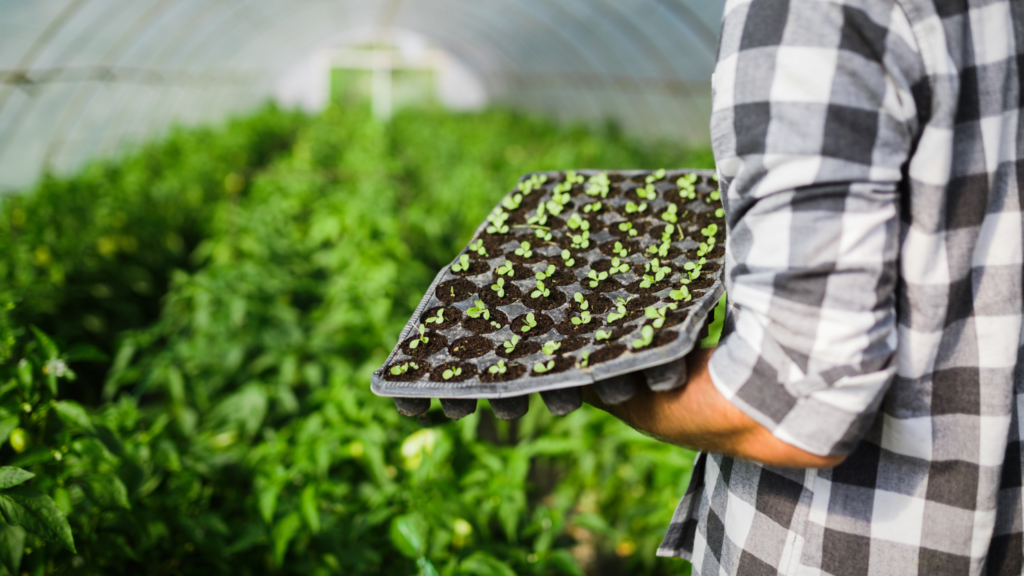
Preparation of seedlings for planting in the greenhouse
It is possible to grow strong seedlings with a good root system and a strong stem.
The initial stage is the selection of a suitable container for sowing. Too heavy, large or tight containers are not suitable for seeds. In addition, it should have good drainage: holes for draining excess water and stones at the bottom. Otherwise, the seeds may rot. The same seedlings that have come down, which will not develop normally and will wither.
Sowing in ordinary plastic cups or pots is the most popular method. They provide protection against root rot, have special drainage holes at the bottom, seedlings from cups are easy to transplant. But they take up a lot of space, they are difficult to carry, because you have to carry each cup separately. Wooden or plastic boxes significantly save space, they can be placed on top of each other. They are easily transported, and the plants are easy to care for. However, pulling the seedlings out of the boxes can damage the roots.
Seeds are sown in paper containers filled with a nutrient mixture. When planting seedlings, the material is simply cut and each cell is placed directly in the ground. The plant is not damaged and does not have to take root. But, unfortunately, it is very difficult to find such paper honeycombs. But there is a worthy substitute for them – peat cups. Porous walls provide the necessary moisture and air access to the roots.
Seedlings are planted in the greenhouse directly with a glass, which decomposes over time and fertilizes the soil. The pot is environmentally friendly and does not contain pathogenic microbes or toxic substances.

When to sow seedlings in the greenhouse
The sowing dates of this or that plant are always indicated on the seed package. In order to correctly calculate the sowing time, several factors should be taken into account:
- The growing season is the time from the appearance of the first sprouts to the full formation of plants. There are early-ripening, medium-ripening and late-ripening varieties. You can find out the features of the plant from the inscription on the seed package. Tomatoes grow in 80-140 days, eggplants – 100-150, sweet peppers – 90-140, and cabbage 50-190. Late tomatoes begin to be planted already in the middle of February, and early ones – in late March-early April.
- The optimal age of seedlings is the time when they easily tolerate diving, quickly take root and rarely get sick. For early tomatoes, this period is 40-50 days, for medium-ripe tomatoes – 55-60, for late ones – 70, for peppers – 50-65, for eggplants – 45-60.
- Temperature requirements. Eggplant is a very heat-loving vegetable, so it is not worth planting seedlings even in a greenhouse early. This should be done when the probability of late frosts has passed. Some varieties of tomatoes and peppers are not so demanding on temperature and can be grown in greenhouse conditions even in frost.
- Preferred harvest time. To obtain a harvest several times a year, seeds are sown more than once.
- Seed germination period and climatic conditions. There are varieties of plants with a cold (determined by soil temperature and humidity) and warm (end of frost) sowing period.
When to plant seedlings in a greenhouse
To transplant small seedlings, it is important to make sure that they have a strong stem and roots.
Before planting tomato seedlings in a polycarbonate greenhouse, you should prepare the sprouts. This process begins 2-3 weeks before the transplant. Watering is gradually reduced, and ventilation is increased. Seedlings are brought out to the balcony for a short time or the apartment is opened to lower the temperature in the room by a couple of degrees. Greens are fed with ash (a 10-liter glass), and in 7-10 days. stop watering. The day before planting, the plants are abundantly watered. You can plant seedlings in the greenhouse between May 1 and 10. At that time, seedlings have 6-8 leaves and a stem of 30-35 cm.
Pepper seedlings are hardened in 10-15 days. The temperature in the room should gradually decrease to 17-18 oC. At first, the room is ventilated only during the day, and after 4 days, the windows are opened at night as well. Seedlings are moved to a brighter place, and the amount of watering is reduced.
To protect against fungal diseases, sprouts are sprayed with a solution of copper sulfate (15 g/10 l) a week before planting in the greenhouse. A few days before planting, the plants are watered well. Seedlings are planted in the greenhouse when the soil warms up to a temperature of 18 degrees. This period is May 25-30 or later, depending on the weather. Around the same time, eggplants are transplanted.

How to prepare a greenhouse?
All experienced summer residents and farmers know that preparatory work in the greenhouse begins already in the fall. It is then that it is disinfected, all waste, unnecessary twine, ropes are removed from it. Doors and windows are securely closed so that wind or precipitation does not damage the greenhouse. If you follow these rules, there will be less work in the greenhouse in the spring – you will not need repairs, pest control, or cleaning. Preparatory work in the spring will consist of the following:
- Polyethylene greenhouses are checked for holes, glass greenhouses for cracks, and polycarbonate greenhouses for frame deflection due to snow loads and cracks in the polycarbonate.
- Thorough cleaning, removal of last year’s tops, mosses, lichens. Next, the greenhouse is washed inside and out. Polycarbonate is cleaned only with soft sponges or brushes with a non-abrasive agent.
- Decontamination (chemicals, natural remedies, biological preparations). Replacing the top layer of soil with humus with mineral fertilizers.
- Application of fertilizers.
To fertilize the soil, it is important to match the plants that will be grown. Some mix loam, manure and peat in a ratio of 4:3:3. Someone simply mixes loamy soil with humus 6:4. You can lay a layer of rotted sawdust, hay or straw on top and sprinkle with peat.
To adapt the soil to a certain seedling, its Ph is measured. According to the indicators, the acidity of the soil is regulated by lowland or upland peat. Sowing of siderates – peas, mustard, cereals – is used as a fertilizer. After the appearance of abundant green mass on them, until flowering has begun, the plants are cut, mulched, and after a few days the seedlings are planted in the greenhouse.