
Cow dung is one of the most affordable organic fertilizers. It is widely used both on an industrial scale and in small towns. Many vegetables respond well to mullein, among which tomatoes are popular in our country. Tomatoes are fed with cow manure several times per season. Fertilizer allows you to get a more abundant and tasty harvest, improve the structure of the soil and facilitate the care of crops. Let’s consider in detail how to feed tomatoes with mullein.
What is mullein, the composition of fertilizer
A nutrient solution based on cow dung is called cow dung. The fertilizer contains a complex of the most necessary substances for the growth of green mass and the fruiting of garden crops:
- nitrogen – for active vegetation;
- phosphorus – without it, ovaries will not form;
- potassium is a macroelement necessary during the flowering period;
- magnesium – participates in photosynthesis;
- calcium and other elements.
Nitrogen and potassium prevail in mullein. Because of this, the timing and number of feedings must be strictly observed so as not to overfeed the plant. An excess of nitrogen causes the vegetative parts of tomatoes to grow to the detriment of the growth of ovaries and fruits.
The chemical composition of manure depends on the feed the animals ate. Nevertheless, cow’s milk is in any case a complex of all macro- and microelements necessary for the normal development of plants.

How fertilizer works: when it is applied, the fertility of the soil increases significantly, as the amount of humus – the nutrient layer – increases. The soil becomes not only nutritious, but also looser. This facilitates access of oxygen to plant roots.
Advantages of feeding tomatoes and other crops with cow manure:
- Versatility – the fertilizer is suitable for both fruit and vegetable and even decorative plantings.
- Raw materials are very cheap, and if the farm has cattle, it is free.
- Manure is an environmentally friendly fertilizer. It is prepared very simply and quickly.
- The effect lasts for a long time: the fertilizer is mineralized gradually, providing nutrition for crops throughout the season.
- All substances in mullein are easily absorbed by plants.
- Diluted manure can be used even if the plants are completely healthy and do not need increased feeding.
- The mullein serves as food for beneficial microorganisms in the soil, helping them to multiply.
- Insoluble compounds in the soil are easily converted into digestible compounds after the application of manure.
- Soil with mullein in the composition warms up faster in the spring.
How to prepare mullein for tomatoes?
It is dangerous to use cow dung in its pure form, as it has a high decomposition temperature. Incorrect proportions of fertilizer lead to burns of the root system, which will greatly weaken the plant.
Cow’s milk is often confused with manure (manure slurry). Fertilizers are prepared from one raw material, but the slurry is dangerous due to the presence of disease-causing bacteria.
The mullein is a fermented solution. While it ferments, the bacteria die. Mulberry works no worse than manure, but it is considered a safer way of feeding.
How to cook mullein for tomatoes:
- First, a bucket of fresh manure is diluted with 4-5 buckets of water. Everything is thoroughly mixed.
- The solution is moved to a warm place. Fermentation times vary from 3-4 days to 2 weeks.
- The container is covered with a lid. It is opened every 2-3 days to mix the solution.
- Cow manure will ferment, as a result of which dangerous microorganisms will die and uric acid will evaporate. Because of this substance, the root system receives burns. Bubbles rising to the surface signal that the fermentation process has begun.
- After about a week, the color of the solution will begin to change to a lighter one. Solid particles will settle to the bottom.
- The fermented mass must be diluted again before use. There should be at least 2 times more water. The recommended proportions for tomatoes are 1:4 or 1:3.
- The solution is infused and stored under a closed lid so that valuable substances do not evaporate.
Advice ! To enrich mullein, some gardeners add fertilizer: 100 g of superphosphate and 500 g of wood ash per 10 liters of liquid.
Rules and terms of feeding
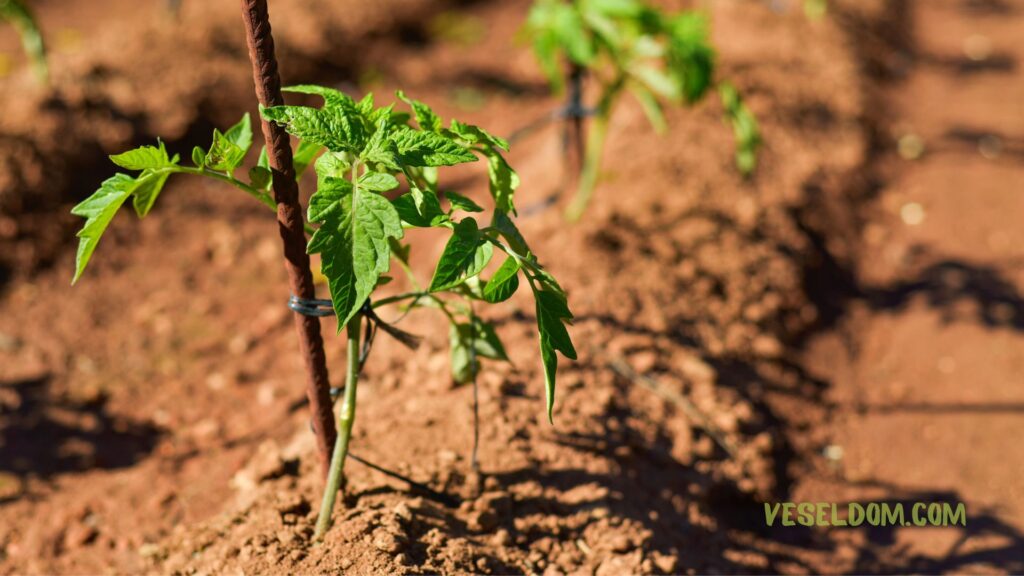
The term for feeding tomatoes with cowpea is spring. Fertilizer is most effective at this time of year.
The first contribution is made at the beginning of the growing season. Repeat – with the beginning of flowering. The third contribution of fertilizer is planned for the formation of ovaries.
In the second half of summer, when the plant redirects its forces to the ripening of fruits, watering with mullein is undesirable: nitrogen provokes the bushes to build up green mass. Because of this, the harvest may not be so abundant.
How to properly feed tomatoes with cowpea:
- The approximate consumption of the finished solution is 10 liters per 1 m2. 0.5 l of fertilizer is enough for one plant.
- After the seedlings take root, the first dose of mullein is applied. Estimated time — 15-20 days after planting on the site or in the greenhouse.
- It is not necessary to water the beds with a solution. To introduce mullein, shallow grooves are first dug. They are made around each plant on one or both sides. It is quite permissible to dig grooves between the rows.
- After watering with manure, the grooves are covered with soil.
- The next watering is carried out no earlier than 14 days after the first.
- It is good if you manage to guess and introduce cowslip on the day of the blooming of the second, and then the third shoot.
What should be remembered
There are known cases when mullein did not bring the expected result. This does not mean that the fertilizer is useless, just that it was applied in an inaccurate dosage or not on time. Soil properties also affect the effectiveness of manure fertilization.
Some recommendations for growing tomatoes for inexperienced gardeners:
- It is not necessary to pour cow’s milk under tomato bushes more than three times per season.
- Do not abuse organic matter if the soil for tomatoes is nutritious and loose.
- It is necessary to pour mullein between the rows only after abundant moistening of the beds.
Alternatives to mullein
Cattle excrement is not the only fertilizer of this kind.
Rabbit droppings are used to feed the bushes. How is he better or worse than cowslip? Rabbit manure also contains nitrogen, potassium, magnesium, phosphorus and a number of other valuable elements. Even the heaviest clay soils become loose after three years of regular application of rabbit manure. This type of organic matter is used much less often than cow manure, but as an alternative it will also be useful.
As in the case of cow dung, rabbit excrement is applied to the soil only in rotted form. Tomatoes are sensitive to an excess of nitrogen, so the dosage of fertilizer is strictly observed: manure is dissolved in water in a ratio of 1:15. Pour the liquid into the grooves around the bushes.
Despite the ease of preparation and availability of mullein, its action can exceed all expectations. Three-time spring fertilizing can more than realistically increase the yield of even a weak variety of tomatoes. However, fertilizing tomato beds with fermented manure should be done with caution: although in dissolved form, it still remains a powerful agent. In case of overdose, instead of benefit, mullein will cause harm. If you follow the proportions, the benefits will not make you wait a long time.