
Manufacturers of greenhouses offer a huge selection of modern and high-quality designs from various materials. But how to choose the right greenhouse among such a variety of options? Let’s analyze the main criteria for choosing the right polycarbonate greenhouse. We will focus on the main types of frames, external coating, the need for a foundation and additional equipment.
The main types of frames
As a material for frames, they use:
- plastic;
- metal;
- tree.
Each of these materials has features, advantages and disadvantages. Let’s analyze each of them in more detail.
Depending on the purpose, there are two main types:
- for homesteading;
- for business
Business buildings will vary in size and structural strength.
Constructions are collapsible or non-collapsible. The first type is good for homesteading. Especially if you only come to the country in the summer. It can easily be made of plastic or wood. The disadvantage of such structures is that they will need to be assembled and disassembled twice a year.
Stationary structures are suitable for both business and ordinary summer residents. They are installed once. Strong, high-quality materials are used for their production. In these cases, durable frames made of metal, for example, galvanized steel, are used. Only such are not prone to corrosion. If the frame is not galvanized, it must be primed and painted. But they still rust and need to be repainted every year.

Outer coating
The building materials market offers several main options for exterior covering:
- Cellular polycarbonate. One of the most popular modern materials. It has excellent operational characteristics. 200 times stronger than glass, capable of withstanding heavy loads. With proper quality, it does not lose its transparency for a very long time.
- Polyethylene film. The most budget option. It transmits light well, retains heat. But it is not strong enough and requires annual removal and installation.
Don’t know how to choose a polycarbonate greenhouse? For starters, don’t buy the cheapest one. Inexpensive polycarbonate can quickly turn yellow, losing its transparency. Then you will have to completely change it.
The choice of cellular polycarbonate for a greenhouse
For greenhouses of the arched type, cellular polycarbonate must be strong and at the same time flexible.
- Thickness and density.
The thickness of polycarbonate should not be less than 3.5 mm. Less suitable for small greenhouses, and not suitable for greenhouses. The optimal thickness of polycarbonate for arched greenhouses is 4 mm, with a density of 0.54-0.57 kg / m2. This is equivalent to a snow load of half a meter. But, if you are going to heat the greenhouse, then you need polycarbonate with a thickness of 6 mm, with a density of 0.84-0.88 kg / m2.
We check the thickness of the polycarbonate using an ordinary caliper. And the density can be found out only by weighing it. For example, a 6×2 meter sheet with a density of 0.57 kg/m2 should weigh 6.84 kg.
- Light transmission capacity of polycarbonate.
In order for a polycarbonate sheet to transmit maximum light, it must be colorless, i.e. transparent. Now some manufacturers of polycarbonate have started painting the panels in different colors, claiming to increase productivity. You shouldn’t believe this, since when the transparency of the leaf decreases, the yield of the plants also decreases. Take colored polycarbonate, for example, for a gazebo.
- The influence of ultraviolet rays.
When choosing polycarbonate, it is important to pay attention to the presence of double UV protection. You can read about the presence of a layer on the protective film or in the passport. Unfortunately, the presence of a layer cannot be determined by eye. The service life of polycarbonate without UV protection is 3-4 months.
It is very important to buy polycarbonate from well-known manufacturers.
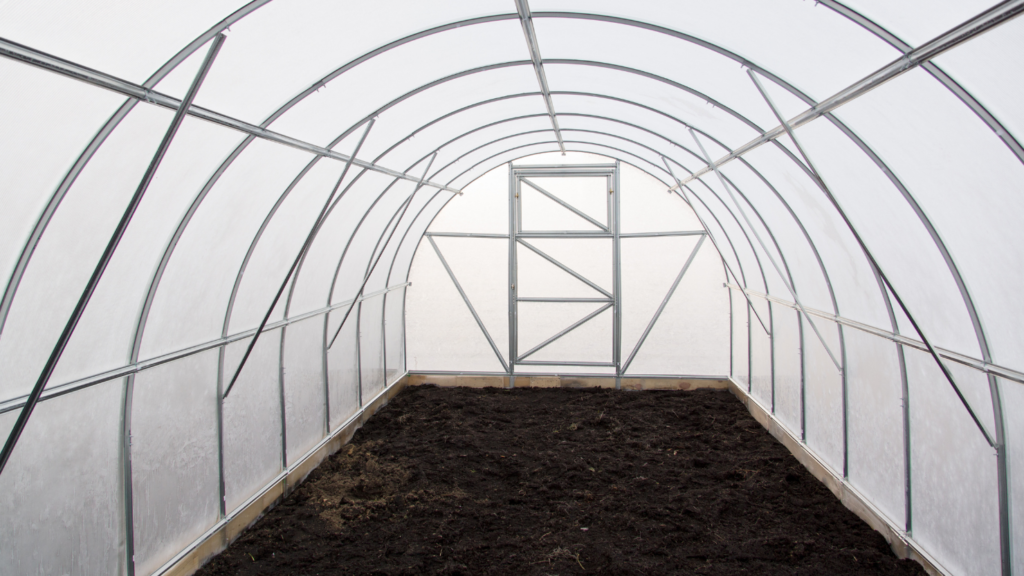
Foundation
The foundation is established in three cases:
- The construction of the greenhouse is heavy. The load from walls or other heavy elements is distributed on the foundation.
- The design is excessively light. In this case, the foundation serves as an anchor. It will ensure good adhesion of the structure to the soil, will allow it to stay in place for a long time.
- If the site has a slope.
The shape of the structure largely depends on what you are going to grow in it and on the amount of free space on your site.
Additional equipment
After choosing a quality greenhouse, you need to decide whether you will use additional equipment.
Additional products include:
- automatic irrigation systems;
- apartments, ventilation systems;
- beds;
- heating devices;
- much more.
The installation of this equipment directly depends on what you grow, whether there is enough sun on your site, whether the greenhouse is well ventilated, whether you will use the greenhouse in the cold season.
Questions remain, how to choose a polycarbonate greenhouse correctly? You can ask our managers for advice and they will answer all your questions.