
The porch can become the main architectural decoration of the house on your site. It connects the building with the surrounding area and creates the first impression of your property. In order to start arranging it, it is important to decide on the design features and materials that will suit one or another style. Harmonious landscape design near the porch of the house can create an unparalleled atmosphere and make your yard an excellent place for relaxing and meeting guests. In this article, we will take a detailed look at the specifics and steps you need to take to create front porch landscaping.
Varieties of the porch by type
The word “porch” defines various structures. However, we usually understand it as a small area in front of the entrance to the house, which can be equipped with several steps.
The number and size of steps may vary. Usually, steps with a height of 170 mm and a width of 340-370 mm are considered comfortable, which should be comfortable for the step of an average adult.
If a railing is installed near the porch, its height is usually about 1 meter. This allows you to comfortably stay in motion.
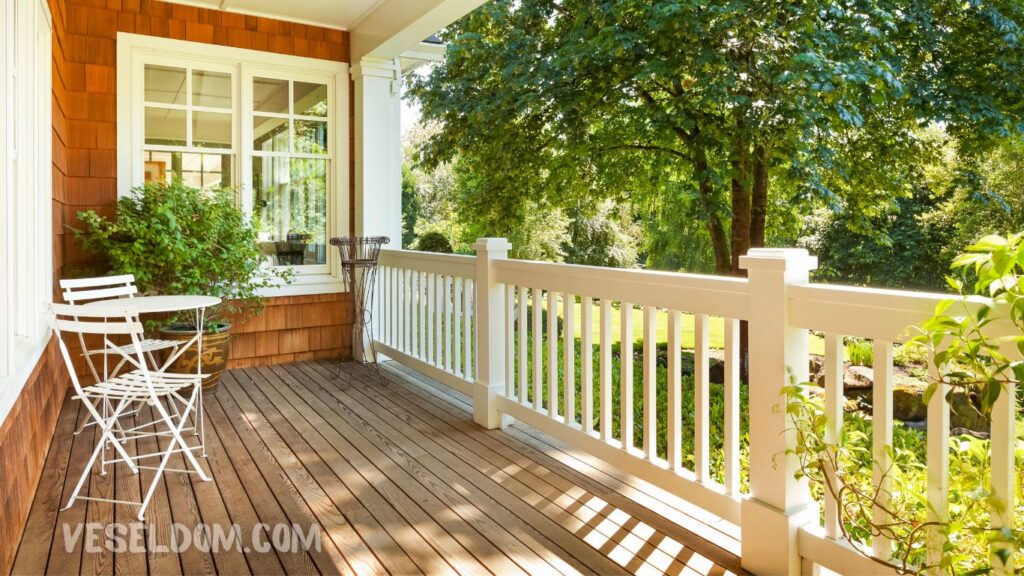
Also, a small terrace or veranda for relaxation can be arranged near the porch. This is a practical solution as it allows you to leave your bag or open the door regardless of weather conditions.
There are several types of porches designed for different purposes. Some of them are designed for welcoming guests, others for outdoor recreation.
It’s important to note that elements such as the ceiling, columns, furniture and landscaping can greatly enhance the curb appeal of your home’s entryway.
An open porch
The most traditional and common type of porch is the front porch. This structure is an open area in front of the door of the house, which can be reached by climbing the stairs. A visor is used to protect against rain. The main purpose of a front porch is to welcome guests and invite them into your home.
A porch in a classic style often has a pitched roof, curved stone railings, rounded posts and numerous steps. Often it is decorated with greenery, although this decoration can be quite restrained, for example, due to the use of conifers.
A vivid example of such a porch is a “gingerbread” house. It has a tiled roof and visor, carved wooden railings and lots of greenery near the entrance.
A closed porch
A more informal option is a covered porch. Here, the guest enters the country house directly into the glazed entrance hall, and the visor and railing are usually absent in this version.
This category includes the European style of the porch, which is characterized by correct forms, well-kept paths and glass doors.
How to design a porch from different materials
When creating a porch, a variety of materials are used, each of which is designed for a specific element:
- Steps: This is a key element of the porch, and their reliability is very important. Usually, steps are made of concrete and lined with tiles or natural stone. It is important that the materials used for the steps harmoniously fit into the design and the materials used for the basement of the house.
- Visor: Modern visors are made of metal profile or metal and can be covered with polycarbonate or tiles. They perform an important function of protection against rain and other weather influences.
- Railings: Although not required, railings often add security and style to a porch. They are usually made of forged metal and presented in metal sections.
Exterior stairs are exposed to winter temperatures and can become icy, leading to potentially dangerous situations. Therefore, when choosing materials for stairs on the porch, special requirements for their strength and long-lasting properties should be observed.
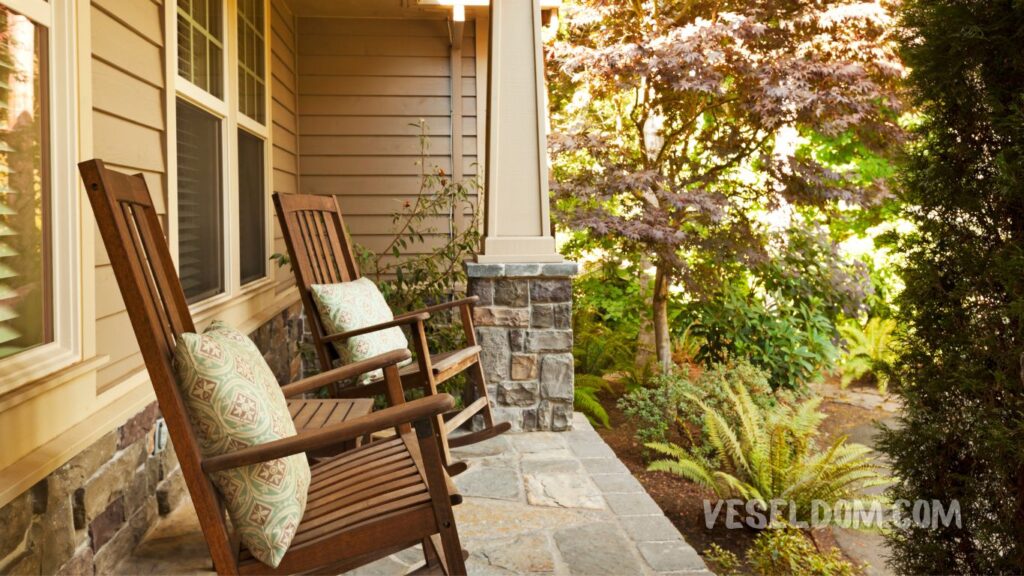
To prevent slipping and provide double safety, special rubber pads are used on the steps. They help prevent injuries and make the porch even safer for you and your guests.
Tree
Stairs made of reinforced concrete, metal or brick provide the longest duration. However, you can use wood as a material for stairs, if you take into account the peculiarities of its care and processing. In the case of using wood for stairs, the platforms under the wooden cladding should be covered with several layers of roofing material. The boards of the stairs should be covered with hot oil, and then treated with varnish or paint.
All wooden parts that are in contact with the ground should be treated with bituminous mastic, and open areas should be covered with oil. It is recommended to use alkyd enamels for painting wooden stairs. With such care and treatment, wooden stairs can serve for a long time, and their overhaul usually needs to be carried out only once every 10 years.
Concrete
The porch area and stairs can be completely made of reinforced concrete. For this, it is necessary to install a formwork similar to that used in the construction of stairs on kosours, with risers, but without treads. Before pouring concrete in the formwork, it is recommended to install a frame made of steel reinforcement. Concrete is distributed layer by layer for better compaction.
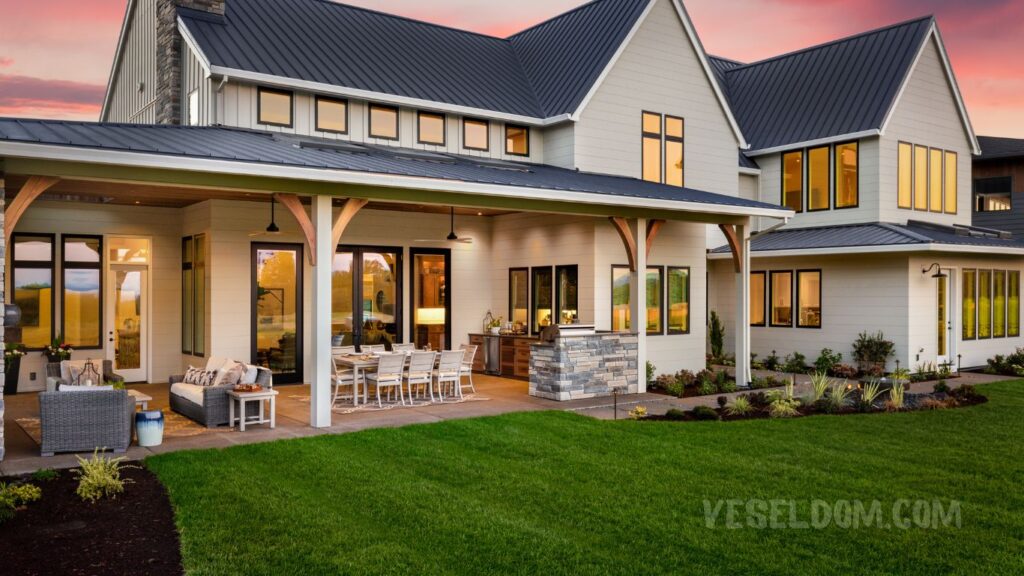
Concrete is also often used to create the foundation of a brick porch and stairs. To do this, you can start with the first step, which should be 1.5 bricks wide. Then the formwork for the concrete foundation of the next stage is installed. To prevent the brick from sliding down, it is recommended to install a safety board on the side of the riser. This process is repeated to create all the other stairs, and then it is completed by lining the surface of the site with concrete.
Metal
Metal is the material associated with railings when it comes to creating a porch. Railings can be made of forged metal or stainless steel with a matte finish. However, it is important to note that metal railings have their own characteristics. For example, they can get very hot in the summer and very cold in the winter. Some homeowners solve this problem by installing railings made of metal posts and wooden handrails, which ensures a comfortable temperature in any weather.
Metal has its advantages:
- Durability: Metal is a reliable material that provides strength and durability to your porch and steps.
- Long service life: Metal perfectly withstands the effects of time and weather conditions, which makes it ideal for outdoor use.
- Appeal: Metal can add a modern or classic style to your front porch, making it visually appealing.
Thus, metal is an excellent choice for those who appreciate strength and style in the elements of landscape design near the porch of the house.
Stone
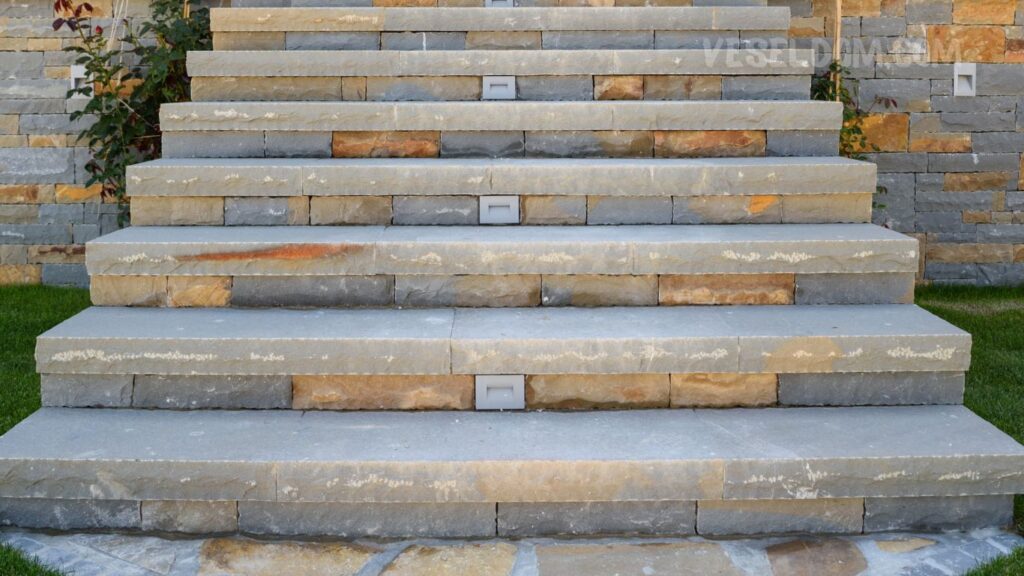
Natural stone is an ideal choice for facing the steps and platforms in front of the entrance to the house. It can be presented in the form of facing plates or natural stones. Usually, the choice of stone for the porch depends on the material with which the basement of the house is lined. The most popular types of stone used for a porch include:
- Marble
- Limestone
- Tuff
- Granite
- Syenite
- Other rocks
These natural materials give the porch an elegant and natural look, and they blend well with the architectural style of the house.
Interesting fact: Porch in Ukrainian culture has always been associated with hospitality and friendliness. This is confirmed by numerous affectionate names of porches, which are still used in folk proverbs and sayings.
Brick
Stairs can be made of brick, which is an excellent and durable material for this purpose. However, it is important to consider that the dimensions of the steps and the porch will depend on the size of the brick you choose. Bricks usually have dimensions of 40 x 120 x 65 mm or 40 x 120 x 88 mm.
When choosing bricks to create a porch, you should consider the following options:
- Ceramic brick: It is made of fired clay and has a characteristic red color.
- Silicate brick: It is made of lime and sand and has a white color.
For safety and convenience, you can add metal handrails to the stairs, which are attached to the brickwork or foundation with the help of brackets. This will add styling and functionality to your porch, while ensuring safety for users.
Tile
Tiles for facing the porch can be of different types: glazed or unglazed, different colors, matte or shiny, and can also have different shapes, such as square, rhombic or trapezoidal.
Facing the porch with tiles gives it an aesthetic appearance. Before laying the tiles, it is important to prepare the base by washing it from dust and possible dirt. It is also recommended to make a preliminary layout to understand how to lay the material, where the joints will be and whether the tiles need to be cut. For cutting tiles, a special tile cutter is usually used, which makes a groove on the tile, along which it is broken by hand.
The solution for facing is prepared from cement and sand, and it is applied in a layer about 3 cm thick, after which the tile is laid and settled with the help of a special rubber hammer.
There are different types of facing tiles:
- Paving tiles: It is used most often and is characterized by high quality and external attractiveness. With its help, you can create patterns or imitate another type of coating, such as marble or granite. However, it should be remembered that it can become slippery during frost.
- Concrete tiles: This is a more economical material, resistant to moisture and stable at night. However, in extremely cold weather, cracks may appear on it.
- Ceramic tile: Despite its slipperiness and elegance, it is not the best choice for a porch because of its instability to external influences.
- Clinker tile: It is ideal for outdoor work. Clinker tiles do not slip, withstand sharp temperature changes and have a long service life with proper care.
Features of the design of the visor and steps
A visor or canopy is used to protect the open porch from rain and sun. When designing it, it is important to remember that it must protect the entire area in front of the door. The frame of the visor is made of a metal profile, and the visor itself is made of plexiglass or polycarbonate.
Plexiglas is a strong transparent material that has been used in construction for many years. However, it is worth considering that it does not absorb sounds well during rain. Modern polycarbonate is a more advanced material that consists of two thermoplastic sheets with a hollow core between them. It has improved sound insulation and perfectly protects the site from ultraviolet radiation. Polycarbonate panels can be flat or corrugated.
It is important to consider that the polycarbonate must be of sufficient thickness, the optimal thickness is from 6 to 8 mm.
The standard size of the visor is approximately 120 cm deep and 40 cm high. However, in private houses canopies can be installed, which cover not only the porch, but also the area in front of it. The size of such a structure is usually from 1.5 to 2.5 m in length and width.
If you are planning to make your own visor, here are the steps you can follow:
- Start designing by creating a structural drawing. Measure the porch and choose the desired visor model, and then combine them in the drawing.
- Create a metal frame using pipes that you cut to the required length and bend with a special pipe bender. To bend the pipes, cuts can be made on the lower side of the pipe every 15 cm. If you are planning a visor with a rounded curved frame, think about the location of the cuts in advance.
- Connect the frame blanks by welding and then grind the seams.
- Cover the visor frame with primer. The number of layers of the primer should comply with the manufacturer’s recommendations, usually two layers.
- Paint the surface of the frame with alkyd enamel also in two layers.
- Bend the polycarbonate sheet and attach it to the frame with self-tapping screws, choosing fasteners with special plugs. It is recommended to leave a small gap, as polycarbonate can expand and contract with temperature changes.
Regarding degrees, their size plays an important role. Steep and narrow stairs can make movement difficult, so their design begins with calculating the correct number of steps. Measure the height of the space in front of the front door and divide by the ideal height of the step, which is usually 18 cm. Next, calculate the width of the landing with the stairs, which should be approximately 30 to 36 cm.
The construction of brick stairs looks like this:
- Prepare the foundation by digging a hole that corresponds to the dimensions of the site and is about 40 cm deep, then compact it.
- Assemble the formwork and consider that the finished concrete slab should have a height of approximately 60 cm, of which 40 cm will be below ground level and 20 cm above it.
- Prepare a concrete solution with a ratio of 1 part cement, 3 parts sand and 5 parts crushed stone. It is important to use clean sand and crushed stone, as well as fresh cement, as cement loses its properties over time.
- After the concrete slab hardens, start laying the steps. If the porch is adjacent to one of the walls, mark the places for the steps on it to control the correctness of the masonry.
- Stretch the construction cord between the ends of the steps and start laying bricks along the entire length.
If you’re thinking of upgrading your front porch to create a cozy area for relaxing and entertaining, here are some ideas:
- Create a place for tea with a table and chairs. Add a “living” table decorated with plants or lawn grass in the center to enjoy herbal tea right on the porch.
- Consider using tiles with interesting designs for decking and steps to give your porch a modern look.
- Put a pergola instead of an ordinary polycarbonate visor and place climbing plants such as morning glory, rose, clematis, quamoclitus, lunotsvet, rhodochiton and many others. Match the color of the pergola to the wall of your house or create a contrast.
- Instead of a plain floor, use tiles that differ in color and design, which will add interest to the interior.
- Consider installing a fireplace on your porch. It can be made of natural stone or materials imitating the effect of fire.
- Add a comfortable bench to the area in front of the front door that will become part of the steps. This will allow children to arrange games and provide additional comfort for rest.
- Provide retractable blinds for the porch, which will protect against overheating on hot summer days and allow you to enjoy fresh air until late in the evening.
- Consider installing a ceiling fan to keep you cool on a hot summer day.
- Add children’s furniture, such as wrought iron railings and wood trim, to a large patio.
- For a cottage-style porch, choose white furniture and light shades on the floor and walls for more elegance.
- Use large pots with large plants at floor level instead of window pots to connect the porch with the entry area.
- Consider adding long curtains that will make your porch more elegant and functional while keeping out the sun and insects.
Did you know that wood has a positive effect on living organisms? Studies have shown that wooden rooms stimulate health and even improve children’s academic performance.
How to decorate the area in front of the porch
Changing the decoration of the doorway or facing tiles on the porch significantly affects the perception of the design of the entrance area. However, it is equally important to properly design the space between the gate and the entrance door.
The central element is the avenue that connects them. It can be made of concrete, brick, porcelain stoneware, or other types of natural stone or tile. You can plant tulips, petunias or marigolds along the alley. This flower border will add harmony and beauty to the entrance area against the background of the surrounding lawn.
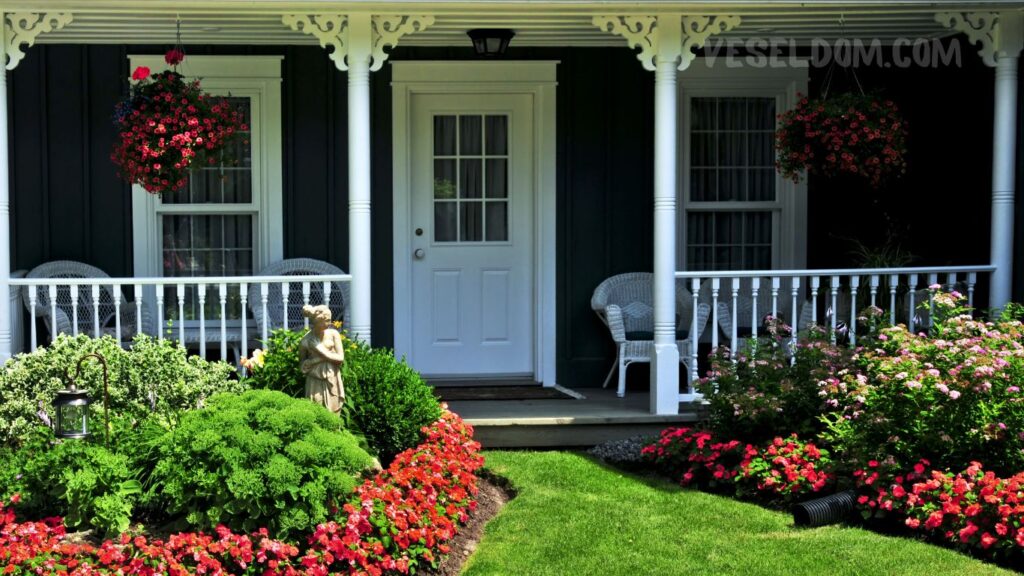
Also, consider the following ways of landscaping the entrance area and choose the one that suits you:
- Create a large flower bed with conifers near the entrance or plant them in large pots.
- Hang hanging flowering annuals in pots. This will contribute to the visual landscaping of the terrace and give a new look to the entrance area.
- Plant slender and bulbous crops in flower beds to create a multi-level effect.
When choosing a design, remember that the emotional mood of the entrance area should be similar to a handshake. Your home porch should not overwhelm guests with grandeur; on the contrary, it should relax and offer friendliness.