
The turkey is a bird that was domesticated by the Mayan tribes about 2 thousand years ago. It was first brought to Europe, including our country, at the end of the 16th century. Recently, we have observed a decrease in the number of turkeys that are raised in the private sector. This has become possible mainly due to the increasing popularity of chicken meat, while turkey meat is less and less mentioned. It is often forgotten that this bird has many advantages over chickens, especially due to the rapid weight gain, which is much higher. It is also worth noting the useful properties of turkey meat. It is easily absorbed, is a dietary product, and also contains more valuable trace elements than chicken meat. Let’s consider the features of breeding turkeys.
For poultry farmers who are experienced in raising chickens, ducks and geese, learning information about breeding turkeys can be very useful. Turkey may become your favorite. Also, this idea of growing large birds can be interesting for young, beginner farmers. Everything you need to provide your family with delicious dietary meat throughout the year can be found in any backyard.
Choosing a breed of turkeys
Before proceeding to the question of how to breed turkeys, you should decide on the breed of birds and their purpose of keeping. The main purpose of growing turkeys is to obtain meat. Cross-breeds or meat breeds are ideal for this. Among the popular crosses, it is worth noting: Grade Maker, Victoria, White broad-breasted and Big 9.
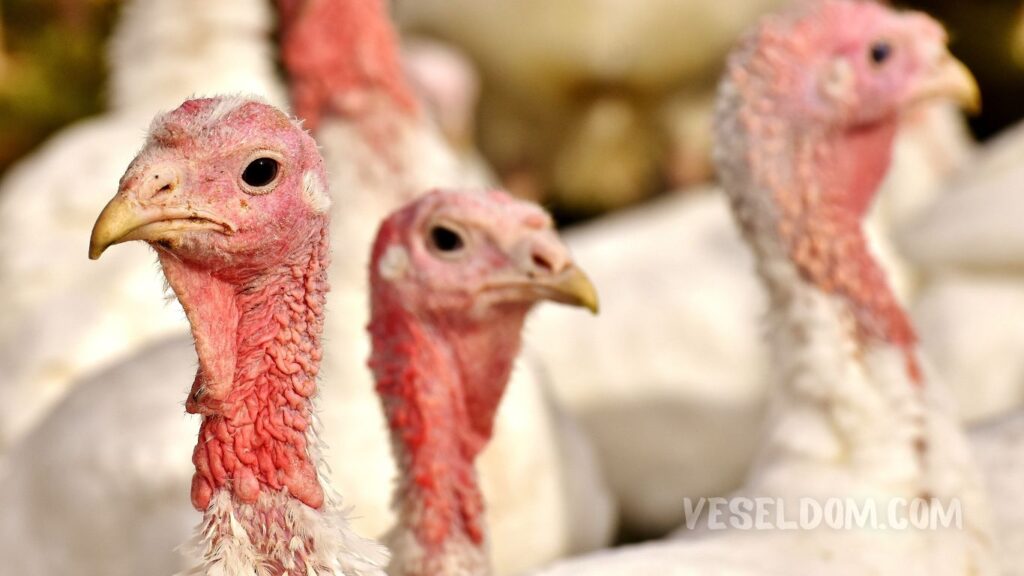
It is best to buy turkey poults from proven breeders, and an even better option is to keep your own brood flock. For this, the largest and strongest individuals should be selected, from which offspring of good quality will be obtained. Chicks are usually bought or reared in early spring, but experienced poultry farmers do not recommend this. They note that turkeys that hatch in March-April can be weak. Under optimal conditions, some of them may die, while others may have serious health problems, such as joint disease. The healthiest and strongest chicks are usually born in July-August.
With repeated reproduction, crosses may decrease in size, therefore, the mother flock selected for breeding should be diluted with new individuals, the so-called “fresh blood”.
Conditions for keeping hatchery turkeys
From the first minutes of their life, turkey chicks need warmth. Make sure that the brooder is heated to a temperature of about 32 degrees. Make sure that the lighting devices are working and there are no drafts in the poultry house. Also prepare the litter before the chicks enter the brooder. As a litter, you can use dark dense fabric, as well as burlap.
Avoid using sawdust or hay as bedding, as this can kill the chicks.
During the first week, keep the temperature in the range of 30-35 degrees Celsius, and then gradually reduce it. Provide constant lighting in the brooder. The litter should be replaced when soiled, but avoid excessive moisture.

Walks for chicks under 1 month are not recommended. If it is decided to let them out for a walk, it is important to provide a flat surface for walking, as unevenness can lead to injury to the chicks.
Feeding hatchery turkeys
The most common feeding tip for turkeys is to use chopped egg as feed. Turkeys accept such feed really well, but there is one important “but”. They get used to eggs and refuse other types of feed. This can create serious problems, as some turkeys may not be able to transition to the special compound feed and die. Therefore, it is better to immediately teach them to consume compound feed for broiler chickens, and to use the egg only as additional feed. If the mother turkey is engaged in raising chicks, such problems do not arise due to hunger. If you do not have your own mother turkey and you are not confident in your skills in raising chicks, it is better to put some chickens with turkeys. These clever furry friends will show you the best way to feed!
Provide frequent feeding of the chicks to ensure their survival. Food should be given to them every two hours, even at night without a break.
Avoid getting the chicks wet during feeding. If a turkey submerges in water and gets wet, it will quickly freeze to death.
After the chicks reach 30 days, they begin to get used to coarse feed, and by the second month they are transferred to the usual diet for adult birds. The introduction of new feed is carried out gradually, starting with fine grinding and grinding. At the age of three months, birds are fed bran and ground corn. Finally, the birds are transferred to an adult diet in 4-5 months.
Conditions for keeping adult turkeys
When calculating the area for keeping turkeys, it should be taken into account that under ideal conditions, 1 turkey per 1 square meter is recommended. However, in practice, turkeys can comfortably exist on a smaller area. For example, if you have a barn measuring 6 x 6 meters, you will be able to raise about 70 turkeys.

It is important to follow one rule: do not allow turkeys to be kept together with other birds or animals in order to avoid the transmission of dangerous diseases that can affect turkeys.
If you do not live in areas with extreme cold, then heating the room is not mandatory. Adult healthy turkeys, if properly fed, tolerate even 30-degree frosts well. Lighting is also optional, as they only need normal daylight, and even in winter they lay eggs.
Perches for turkeys should be built only if you choose a breed for obtaining eggs, and not meat breeds. Perches are not recommended for heavy crosses that gain a lot of weight, as the birds may try to take off, which can lead to injury.
It is better to use removable feeders that are easy to clean and treat with antiseptics. Nipple drinkers are the best option, as they ensure cleanliness and dryness for the birds.
Turkeys like to take dry baths to clean their feathers from insects. A sand and ash trough can be installed in the pen or shed to meet their needs. The floor should be cleaned as necessary when it becomes wet. Sawdust can be used to combat excessive moisture. Once a year, a general cleaning is carried out, during which all surfaces are cleaned and disinfected with a Virocid solution.
Nutrition of adult birds
A balanced diet is an important aspect of raising healthy and strong turkeys. For this, different types of feed are used, such as compound feed, wet mixes, and you can also feed the birds with kitchen waste. Shellfish, chalk, eggshells and fresh greens can be added to the diet. In winter, when the birds do not have the opportunity to peck at the grass on the pasture, it can be replaced by germinated cereals and vegetables.
The simplest feeding option is the use of ready-made compound feed. Starter compound feed is suitable for newly hatched chicks up to the age of three months. It is sold as granules or grits and contains main ingredients such as wheat and corn. During two weeks, one chick should eat approximately 600 grams of such food.
Average combined feed is intended for young birds from 15 days to 32 days, but it is recommended to start using it for birds starting from 30-45 days of age. Consider that within 14 days one bird can eat about 2 kilograms of compound feed.
Finishing compound feed is used for fattening birds from the age of 60 days until the time of slaughter. The consumption of compound feed depends on the appetite of the birds, the more they eat, the more weight the turkeys gain. On average, heavy breed males can consume up to half a kilogram of feed during the day, while females consume 100-150 grams less.

Compound feed is a convenient option, since you do not need to prepare food mixtures and determine the proportions of ingredients yourself. However, they can be quite expensive. In this case, a possible option is to make compound feed yourself.
The use of feed for animals and other types of birds is possible, but one should be careful and consider only certain options. For example, the use of pig compound feed is categorically not allowed, but calf compound feed can be used for feeding birds for a short period. Chicken feed, particularly for broilers, is often used but should be supplemented with protein supplements such as cheese, bone meal or fish/meat waste.
In general, for those farmers who want to engage in turkey breeding, you should be prepared for the fact that it requires some effort and costs. Being able to grow certain grain or vegetable crops yourself in large batches, which can then be used as bird feed, can be a big help.