
It is difficult to imagine a modern landscape without a smooth, uniform green carpet: it is the basis of any compositions and simply an independent element of the decor of the courtyard area. Creating a good lawn is not an easy task. Certain knowledge and skills are required so that the completed coating pleases the eye. In the article, you can find out what types of lawn there are for landscape design, and the rules for their selection, depending on your needs.
What is a lawn in landscape design
A lawn is a natural decorative covering created by artificial sowing or planting of plants that form a uniform and dense carpet on the surface of the earth. A lawn is used for a variety of purposes in landscape design, and it can play different roles in the design of a plot of land.
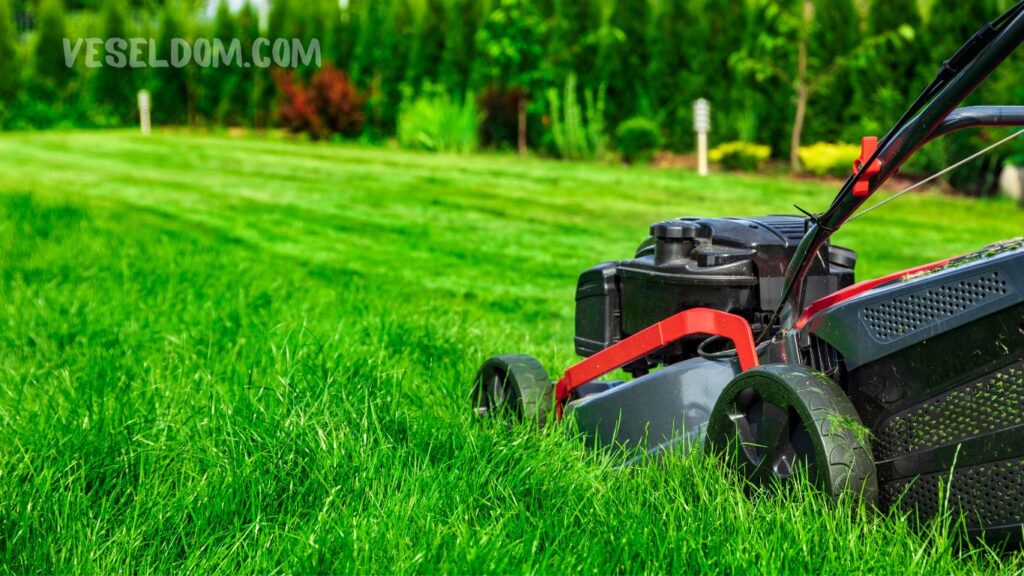
The main functions of a lawn in landscape design:
- Aesthetic function : The lawn creates an impression of well-kept and natural beauty on the territory. It has the ability to visually change the size of the garden or yard, making them larger and more spacious.
- Emphasizing architectural forms : Lawns help highlight the architectural features of buildings or other structures, highlighting them among the green cover.
- Psychological impact : The green color spectrum of the lawn promotes relaxation and mood improvement. It creates a comfortable atmosphere for rest and relaxation.
- Environmental role : Lawns help improve air quality by absorbing carbon dioxide and releasing oxygen during photosynthesis.
- Soil Conservation : Lawns help prevent soil erosion and retain moisture in the soil, reducing the risk of wildfires and droughts.
- A place for active recreation : Lawns are ideal for various types of activities such as picnics, sports games, outings with children, etc.
In landscape design, there are different types of lawns, each of which has its own unique characteristics and maintenance requirements. Choosing the type of lawn depends on the functions you want to get from it, as well as on climatic conditions and regional characteristics. In the following sections of this article, we will look at the different types of lawns and their characteristics so that you can choose the best option for your landscape design.
Types of lawn
Natural
A natural lawn is an area of land covered with natural grasses that must be regularly mowed and maintained. This type of lawn is the most affordable and environmentally friendly option, as it does not require additional efforts to create it – it already exists naturally. The plants that make up the natural lawn are often quite resistant to mechanical impact, such as trampling. Natural lawn can be used as an independent element of landscape design or in combination with other decorative elements, creating a green carpet in the most accessible places.
Moresque
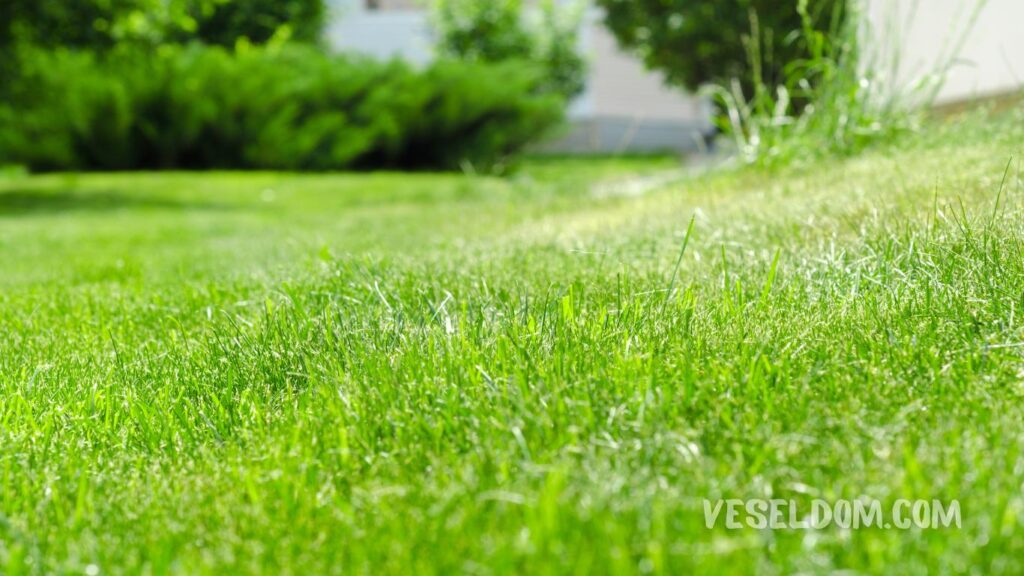
The lawn of the Moorish type consists of a mixture of grasses and flowering plants, and resembles a bright lawn, on which low-growing grasses and wildflowers grow in harmony. It is usually used in places where you need to create a design as close to natural as possible. There are two main variants of the Moorish lawn: plain and colorful. Plants are selected to ensure uniform and long-lasting flowering throughout the summer. Such a lawn should be mowed only after the end of the flowering period.
Importantly! Thanks to the large number of wildflowers, the Moorish lawn attracts bees and butterflies, which adds even more naturalness to the composition.
Ground floor
Parterre lawn belongs to the elite types of lawns and is used to decorate the front part of the site. The area on which the parterre lawn is created must have a perfectly flat topography, as the smallest irregularities will be noticeable. The lawn is formed by hand, only those types of grass are planted that are able to form a dense and uniform green carpet of a small height during the season. Constant mowing (twice a week) is mandatory, and it is allowed not to increase the length of the lawn by more than one centimeter. Walking on the ground floor lawn is prohibited.
Garden and park
Garden and park lawn is also called ordinary or universal. It is less refined, compared to the parterre, but it looks just as beautiful. In addition, it is easier to care for. The lawn is formed from various grasses that do not require frequent mowing. Its height is approximately 10-15 cm.
Special
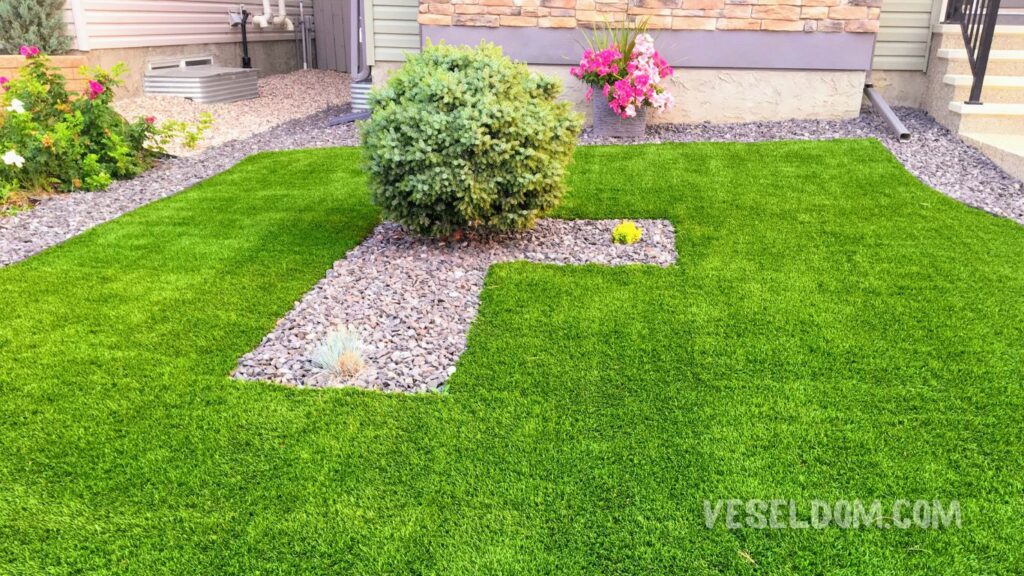
The special lawn consists of a dense grass cover, which has high resistance to external influences. The main requirements for plants in this lawn are unpretentiousness and resistance to bad weather and other external factors. The special lawn is used for landscaping both public and private areas, as well as for creating a green cover resistant to chemical influences.
Sports
A sports lawn is a grass cover on children’s and sports grounds. It should be as resistant to trampling as possible and able to recover quickly, therefore fast-growing plants with increased elasticity, wide leaves and dense stems are used for its creation.
Meadow
A meadow-type lawn resembles a forest clearing and is often used for greening large areas, gardens, areas in front of the house and other nearby places. This lawn does not need frequent mowing – 3-4 times a season is enough.
Rolled
A rolling lawn is ideal for those who do not have time to plant grass. After two years of cultivation of forage by specialists, it is cut together with part of the soil and rolled into a roll. It can simply be deployed in the desired location. Plants on a rolled lawn withstand mechanical impact and are not damaged by the actions of domestic animals that try to dig into the soil. Weeds also do not grow through this lawn.
Annual
An annual lawn is grown from the seeds of a single species of plant that has a short growth cycle and usually completes its life cycle within one season (spring to fall). After the growing season ends, these plants will die. Often, such a lawn is used as a test option before sowing the site with perennial plants.
Importantly! If flowering plants are included in the annual lawn, the green cover can be restored for the following year, provided that the cover is not mowed after flowering.
For extreme places
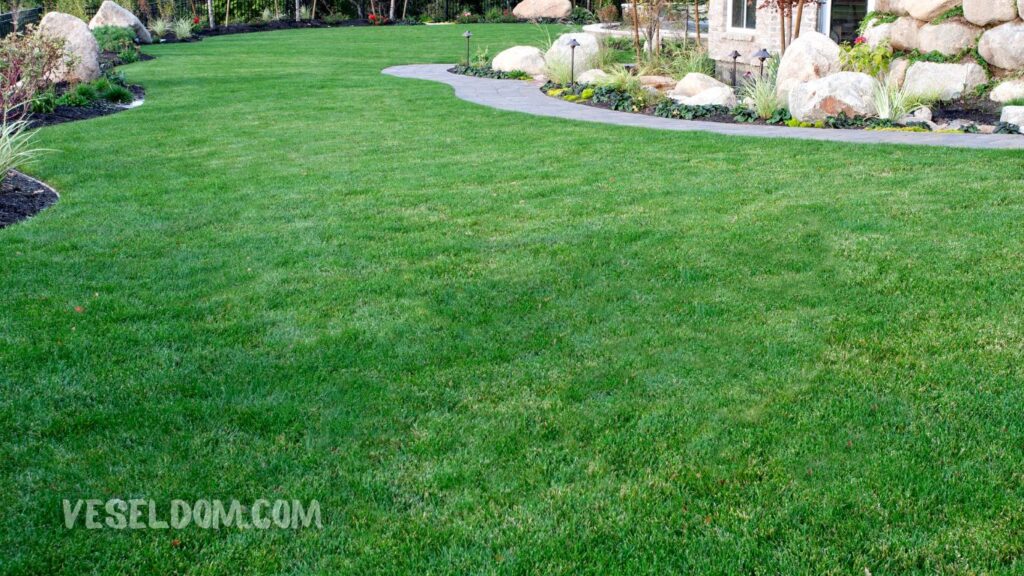
Lawn for extreme locations is used to solve specific tasks, such as strengthening slopes or preventing soil erosion. For these purposes, the seeds of plants are used, which are undemanding to growing conditions and resistant to environmental influences, but they should be low. The main requirement is the intensive growth of a branched root system and the formation of dense shoots. Such a lawn is mowed 2-3 times per season, and fed and irrigated as needed.
How to choose the right type of lawn for your plot
Choosing the type of lawn depends on the goals you plan to achieve on your site:
- Creating a flowering lawn: If you dream of a flowering lawn, then a Moorish lawn is suitable for you, which includes plants such as cornflowers, poppies, gypsophila, marigolds, flax, forget-me-not and red clover.
- Decor of the territory near the entrance: To decorate the territory around the entrance, a parterre lawn is suitable for you, which includes such plants as red fireweed, broom and meadow grass.
- Garden and park landscape: If you dream of creating a garden and park landscape, then you should choose a garden and park lawn, which includes resurrected perennial, common comb, meadow timothy and thin-legged sedge.
- Under the playground: To create a playground for games and sports events, a sports lawn is suitable, the composition of which includes meadow grass, broom and red fireweed.
- For picnics: If your area is intended for picnics and recreation, you can choose a natural lawn (made from natural grasses) or a rolled lawn that includes meadow sedge, meadow ryegrass and red sedge.
In addition to your goals, you should consider the location of your plot, the nature of the soil and the topography:
- A flat area with fertile soil: A parterre lawn is suitable for such conditions.
- Infertile heavy soil with an inappropriate location: Garden and park lawns are suitable for such areas.
- An area for active recreation and games: For walking areas and playgrounds, you can choose sports or rolled lawn.
- A well-lit place with any soil: Here you can establish a lawn for sunny areas, using red sedge and other sunny types of grasses.
- Areas in the shade near fences, buildings, and under trees: For these conditions, choose a shade-loving lawn that includes ryegrass, ragweed, and red sedge.
When choosing a lawn, be sure to consider all of these factors to ensure the best result for your area.
Rules for the design of the lawn on the site
In order for your green lawn to always please the eye, it is necessary not only to sow selected grass seeds, but also to provide them with careful care. In addition, before sowing the seeds, it is necessary to properly prepare the soil. More details on this below.
Necessary tools
To decorate the lawn, you will need the following tools:
- rake – for cleaning garbage and leveling the soil;
- shovel or pitchfork – for digging up the site and uprooting unnecessary vegetation;
- skating rink – for leveling the soil;
- fan rake – for drip sowing of sown seeds;
- a cutting machine or a saw – for decorating the edges of the lawn.
Soil preparation
To begin with, the selected area must be cleared of debris, stones, and uprooted bushes, young growth, and stumps. If there are construction residues on the site, they should be dismantled and removed completely. Next, it is necessary to remove weeds and use herbicides, as weeds are more durable compared to decorative vegetation and will sprout through the lawn.
Usually, the lawn is formed on a small hill, about 2-3 cm above the ground level. For this, it is necessary to add nutritious soil, especially if the area around the house is uneven (contains pits or hills). Before bringing the soil, the site should be dug up, all communication works should be performed and drainage ditches and wells should be isolated. After that, with the help of a roller, the soil should be carefully rolled. Nutrient soil should be evenly distributed over the territory using a rake.
Sowing grass
Lawn grass is sown in the same period as other plants – in spring or autumn. The exception is the rolled lawn, which can be laid during the entire period from spring to autumn.
If spring sowing is planned, it is advisable to carry it out approximately from April 10 to 20. By that time, the soil should have warmed up so that the seeds do not freeze at night, and at the same time, it should not be too wet to provide additional watering. Before sowing, the soil should be leveled with a rake to avoid large mounds. It is advisable to use planters for uniform distribution of seeds on the surface. The first shoots should appear at the end of April, and already in June your plot will be covered with a uniform green carpet.
Interesting fact: About 10,000 blades of grass grow on each square meter of rolled lawn.
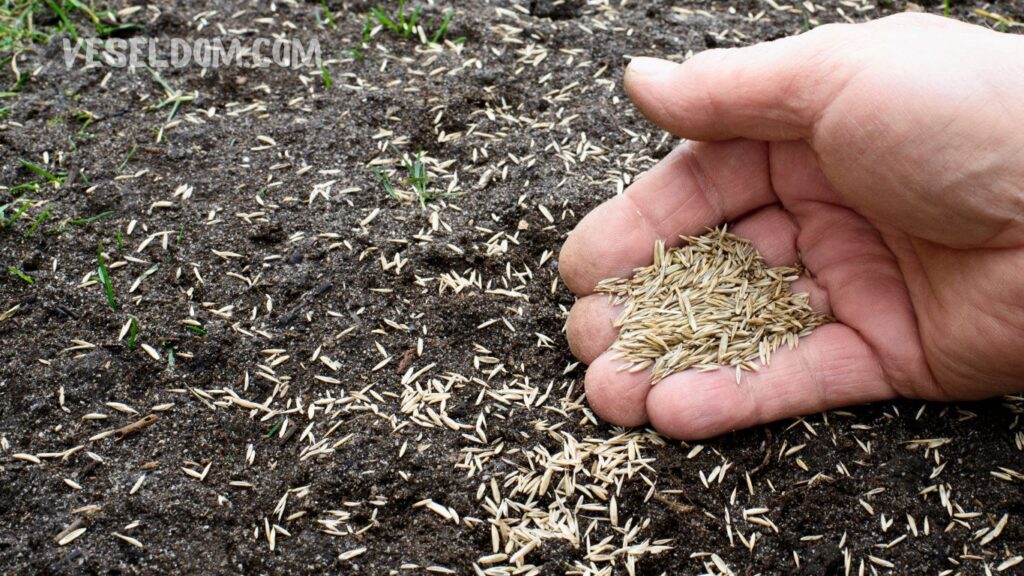
Autumn is an ideal time for sowing a lawn , because the soil is already saturated with moisture, there is no dry and hot wind, and weeds do not grow so intensively (their removal can be postponed until spring). However, it is important not to delay sowing, as late sowing will not allow the plants to establish properly before the onset of cold weather. It is best to sow in late August or early September. The sowing technology is the same for any season and includes the following steps:
- Applying mineral fertilizers and loosening the soil with a rake.
- Seed dispersal.
- Burying seeds into the soil with a rake. You can cover them with peat about 1 cm thick.
- Compaction with a roller so that the seeds do not remain on the surface.
- Watering the site with rain sprinklers or daily drip irrigation.
Features when using a rolled lawn
Landscaping with rolled lawn can seem like a costly task for many, as the cost of rolled lawn exceeds the cost of other types of lawns, and it also requires additional funds to be laid.
However, it is not difficult to do this work yourself if you know the nuances of this process:
- Clear the garden of plant debris. Before starting to lay a rolled lawn, it is important to carefully remove all remaining vegetation and debris from the future area.
- Arrange the rolls in a staggered manner. Lay the lawn rolls so that they are better connected. This will help to avoid visible gaps between them.
- Lay the workpiece with a rolling pin. It is important to carefully compact the rolled lawn using a roller. This will help ensure better contact between the lawn and the soil.
- Remove excess soil with a knife or shovel. After laying, excess soil may remain, which should be carefully removed.
- After laying, sprinkle the seams with a mixture of sand and earth and sprinkle abundantly. This will help fill all the gaps between the rolls and provide optimal conditions for the lawn to grow.
- Water again after 7 days. Water sparingly. The lawn needs abundant watering after laying, but it is important not to overwater to avoid leakage.
- Carry out the first haircut two weeks after laying, performing it across the rolls. This haircut will help the lawn to take root and provide an even, healthy appearance.
After a month, your lawn will be ready for active use.
Interesting fact: The most expensive lawn in Australia grows around the government building in Canberra. An amount exceeding one hundred thousand dollars is spent annually on his care. A large green lawn boosts the mood of government members and increases their productivity.
How to care for a lawn
A lawn requires careful maintenance throughout the year, and this process includes actions to ensure healthy grass growth, winter preparation and maintaining an attractive appearance.
Irrigation : Irrigation procedures are best carried out in the morning before sunrise or in the evening after sunset, when the heat has already subsided. It is important to avoid watering in hot weather, as the moisture can evaporate faster than the plants can absorb it. The amount of water depends on weather conditions, but the soil should soak to a depth of about 10 cm without forming puddles on the surface. The frequency of watering depends on the weather: in the hot season, especially on sandy soil, it should be watered twice a week, in the cold season, once a week and a half is enough. Grass on loam and clay soil is less demanding on water.

Feeding : The lawn needs additional feeding in spring, summer and autumn. Feeding helps the grass to grow intensively and compete with weeds. It is best to feed after cutting before watering. It is best to apply nutrients using a sprayer. For spring feeding, it is optimal to choose nitroammophoska, which contains the necessary elements. The calculated dose is from 20 to 40 g per 1 m². In summer, it is recommended to use complex fertilizers. In addition, potassium salt should be applied twice a season (from 15 to 20 g per 1 m²). Autumn fertilization is aimed at preparing the lawn for winter and involves the use of potassium-phosphorus complexes. The best choice is bone meal (from 2 to 3 tablespoons per 1 m²), and closer to the onset of cold weather – manure (3-4 kg per 1 m², but no more than once every 3-4 years).
Mowing : Lawn mowing plays an important role in lawn care, helping to maintain an aesthetic appearance and stimulating grass growth. It is recommended to cut the grass in dry weather, but if the lawn is very overgrown, it is permissible to cut the grass in cloudy weather or early in the morning, when the dew is still on the grass. Change the direction of the mower with each mowing cycle, as the grass tends to lean in the direction of travel. Collected grass can be used for compost or temporarily left on the lawn for protection from the sun in the heat. The recommended frequency of cutting is about once every 1-2 weeks, and the size of the cut should be one third of the height of the stem.
Restoration : Lawns age over time, the density of the cover decreases, and bald patches may appear on the surface. To restore the lawn, it is necessary to sow these areas with fresh grass. This process keeps your site looking beautiful and healthy.
The lawn plays an important role in landscape design and is intended for active use. Even if you don’t have the time or money for an elaborate landscape design, it’s enough to sow your lawn with a green carpet to give your area a magical look. The lawn reflects on the general appearance of your yard and adds to it an atmosphere of comfort and beauty.