
A neat lawn has always been the dream of any summer resident or owner of a private house. However, in practice it turns out that this element of landscape design requires even more attention and painstaking care than such usual vegetable beds. But there is a simplified version of creating a lawn, which is called a lazy lawn. In this case, lawn grass care becomes much easier, and your yard will quickly turn into a green lawn. In this article, we will reveal the details and details of how to create a beautiful lawn in the country without much effort, so that you can enjoy its beauty and comfort with minimal effort.
What is a “lawn for the lazy”
Creating a decorative lawn can seem like a difficult and time-consuming task. The traditional planting process involves many steps, from preparing the soil to sowing the grass seeds. However, there is a simplified version, which is sometimes called a “lazy lawn”. Such a lawn differs from the classic version in that it is created using zoned grasses that are more easily adapted to local climatic conditions.
The main stages of creating a lawn for the lazy:
- Cleaning the area: thoroughly remove all vegetation on the site of the future lawn, including weeds. You can use powerful herbicides to eliminate the root system of weeds.
- Leveling the soil: create a level surface with a five-degree slope to avoid stagnant water on the lawn.
- Digging the soil: loosen and loosen the soil to prepare it for the seeds.
- Fertilizers: add starter mineral and organic fertilizers to the soil.
- Sowing Grass Seed or Spreading Lawn Rolls: Sow grass seed or spread lawn rolls on prepared soil.
- Rolling: press the seed into the ground or compact the lawn rolls.
Lazy summer residents can choose a less expensive way, limiting themselves to only removing weeds and sowing grass seeds. However, it is worth noting that in this case the lawn may not look as smooth, fresh and beautiful as a classic lawn, which requires more care. The use of zoned grass reduces the need for additional lawn care.
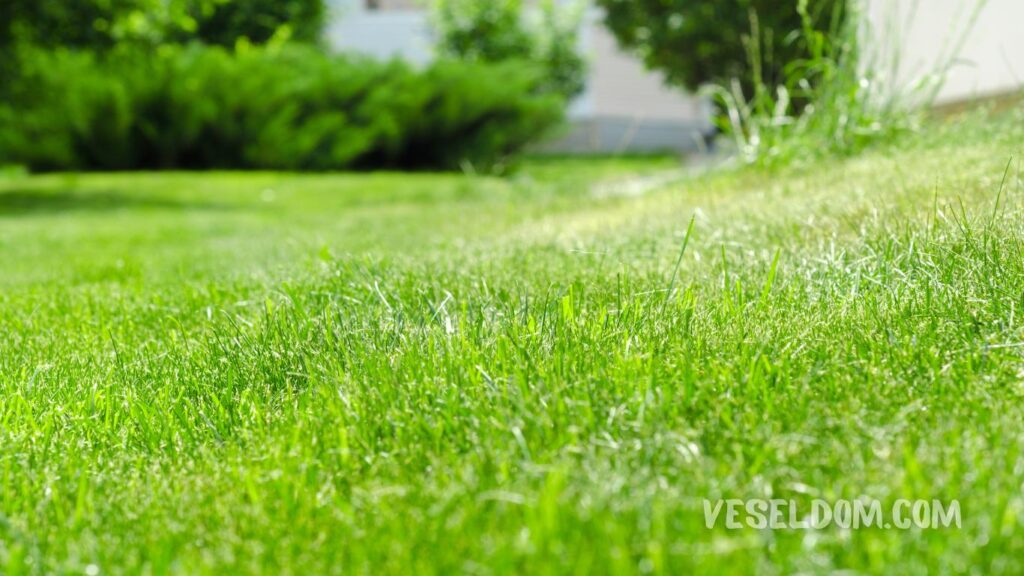
Let your lawn become a place of pleasant relaxation in nature, where you can relax on deckchairs, enjoying the green lawn. Remember that even in the case of a “lazy lawn” it is important to follow the technological requirements to preserve its beauty and health.
What mixture of seeds to choose for planting
In addition to unpretentiousness, herbal mixtures for minimal care should have two more properties – small height and slow growth rates. In this case, the lawn will not need regular mowing, and in particular, working with a lawnmower is one of the most unpleasant aspects of maintaining decorative grass.
Among the types of field plants that better meet the mentioned criteria, the following cereal crops are distinguished:
- 4 types of ostrich – red (Festuca rubra subsp. Rubra), red modified (Festuca rubra commutata), red hairy (Festuca rubra trichophylla) and sheep (Festuca ovina subsp. Duriscula);
- thin (Agrostis capillaris) and creeping (Agrostis stolonifera);
- Poa pratensis (Poa pratensis).
Kostrytsia (oatmeal) is characterized by high density, a strong root system, density and the ability to grow intensively, but not in height, but in width, drought resistance, and the ability to adapt to different climatic conditions.
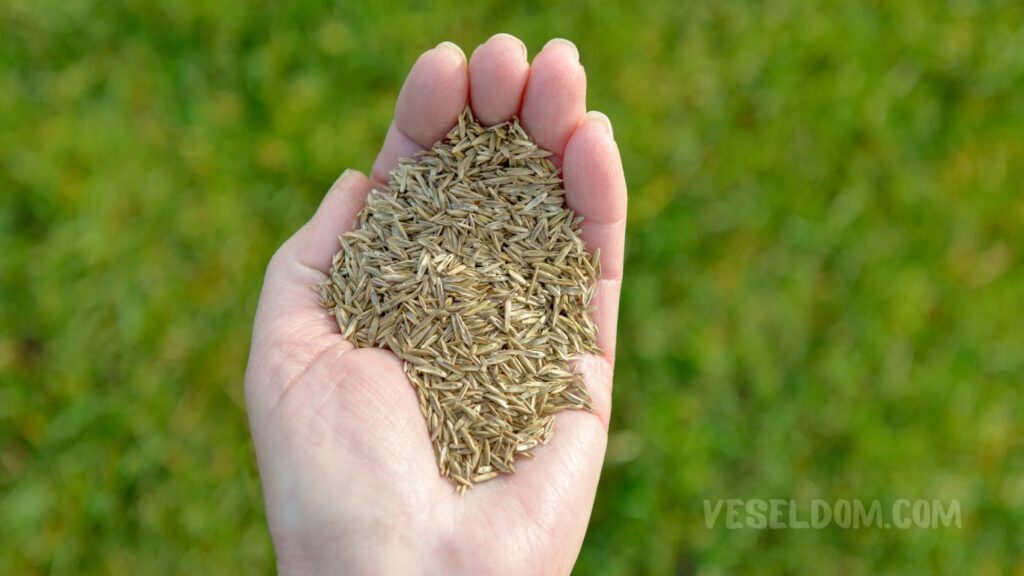
When buying meadow grass seeds for planting, you can combine them in different proportions, choosing the most successful mix by trial and error. A simpler option is to use ready-made mixtures in which each seed, in addition to everything else, has undergone preliminary calibration and treatment with modern growth stimulants.
The following mixtures are used for a lazy lawn:
- GermanGrass Hummingbird (4 types of sedges + meadow grasshopper);
- Greenfield Mini Rasen low-growing (4 types of firewood + raised pasture);
- Mini herb mixture from DLF Trifolium (3 types of sedge + meadow grass + resurrected perennial);
- “Slow growth” from the company “Family Garden” (2 types of kostyria + 3 types of sedum);
- Little Grass Dr. Green Jacklin Seed (2 types of jacklin + meadowsweet);
- Greenline Niedrigwachsender slow growth (2 types of kostyrica + 3 types of sparrow).
Often, in search of a mixture for minimal care, summer residents come across a mix under the promising name “Lazy”. It can also be planted on your plot, but it is important to keep in mind that this complex, in addition to two types of fescue, the thin-legged meadow and the raised meadow, also contains 5% white clover. Thus, “Lazy” is a classic option for an unpretentious lawn in the Moorish style, it is this direction of landscape design that provides for the presence of bright wildflowers on the lawn, in addition to strict green grass.
How to plant with your own hands
Those who believe that it is enough to purchase a suitable grass mixture and simply sow it on an untreated area on top of already existing vegetation in order to admire a full-fledged lawn in a couple of weeks, should not be tempted. Even a lazy version of a green lawn requires some effort, otherwise the purchased seeds simply will not be able to germinate in a dense layer of weeds.
Do you know? The tallest grass on earth is bamboo: the length of this giant can reach 40 m, and the thickness of the stem is 0.8 m. It is interesting that the second place of honor belongs to a plant, the herbaceous nature of which many people do not even suspect, namely, we are talking about about such a herb as a banana.
Site preparation
For spring planting of grass, it is recommended to start preparing the plot already in autumn. It is better to choose an open place, which, if possible, is well lit by the sun. If there is shade from trees or buildings, it is worth taking this fact into account when choosing seeds for planting, since some types of grass require more light than others.
Many plants can grow on the site of the future lawn, so before sowing, you should remove all vegetation along with the root system. One of the ways to do this is to deeply dig the area, and when removing large fragments of sod, simply wash the soil from the root mass of plants. Other plant parts can be collected separately for further removal from the site.
Pay attention! Plants that are removed to create a lawn decompose and form an excellent organic fertilizer. Therefore, you should not be upset if a little fertile soil remains on the insects along with the roots.
After clearing the territory of vegetation, it is possible to dig up the soil, which will contribute to the development of the soil and improve its structure. However, in the case of creating a lazy lawn, this step can be skipped. It is important to ensure good drainage, especially if there is a risk of water stagnation in the area. To do this, you can create a small slope on the lawn so that excess water drains by gravity.
Before sowing, you can apply starter fertilizer – a complex mineral top dressing of nitrogen, phosphorus and potassium. Please note that some herbal mixtures already contain the necessary nutritional components in granular form.
For heavy soils, it is recommended to additionally add sand (up to 10 liters per 1 sq.m.), which will lighten the soil and promote slow grass growth, which will make it possible to mow the lawn less often. After leveling the area and tamping, the finished lawn can be sown or planted on it. To compact the land after sowing, you can use any available material, or simply walk with small steps on the leveled surface.
These steps will help you create a beautiful and healthy lawn that will not only beautify your yard, but also provide a place to relax and care for it will be relaxed and easy.
Sowing process
Sowing lawn grass is possible throughout the year, except for the winter period. The optimal time for sowing is the period from August to the end of September. This is due to two factors. First, young plants take root better in moist soil and comfortable warm weather, so sowing before dry and hot days can reduce the risk of seedling loss. Secondly, in contrast to winter crops, forage should winter already germinated, which contributes to faster growth in the spring.
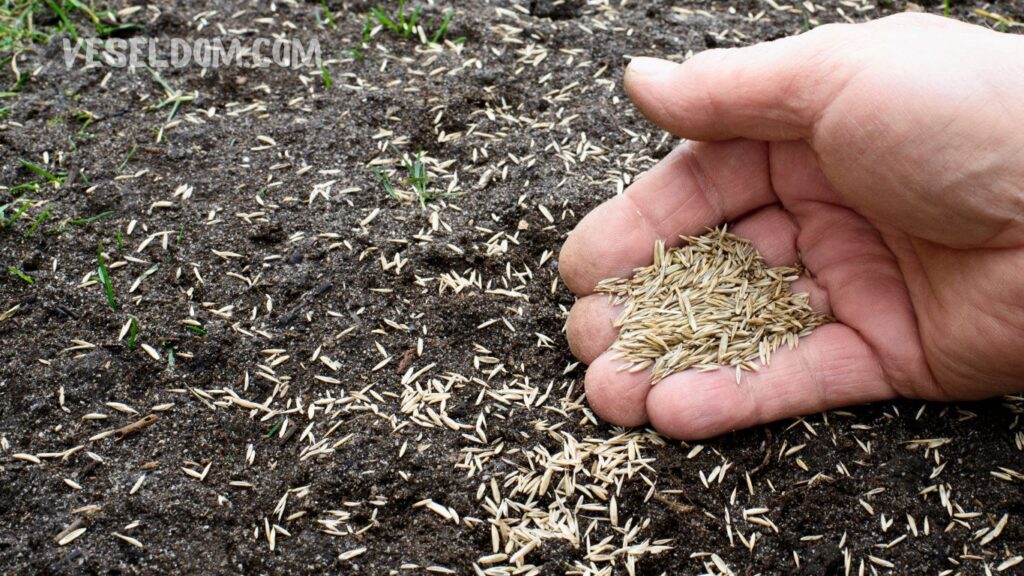
Optimal conditions for intensive germination and active shoot formation of meadow cereals are high air and soil humidity, short daylight and moderate temperatures.
It is recommended to choose a windless day for sowing, and the soil should be dry. The number of seeds required for sowing a unit of area depends on the selected composition of grass mixtures and is indicated by the manufacturer on the package. For example, about 25-30 grams of mix will be needed for 1 square meter of “Lilliputian” mixture. The seeds in the bag should be thoroughly mixed before sowing for an even distribution of different types of plants.
If there is no special seeder, sowing can be carried out manually. There are two possible ways. The first is that the prepared mixture is divided into 4 equal parts, and then scattered in turn in four different directions: along the site in one direction and back, then across the site – also back and forth. The second method involves two passes along the site, scattering the seeds crosswise: first from left to right, then from right to left (or vice versa).
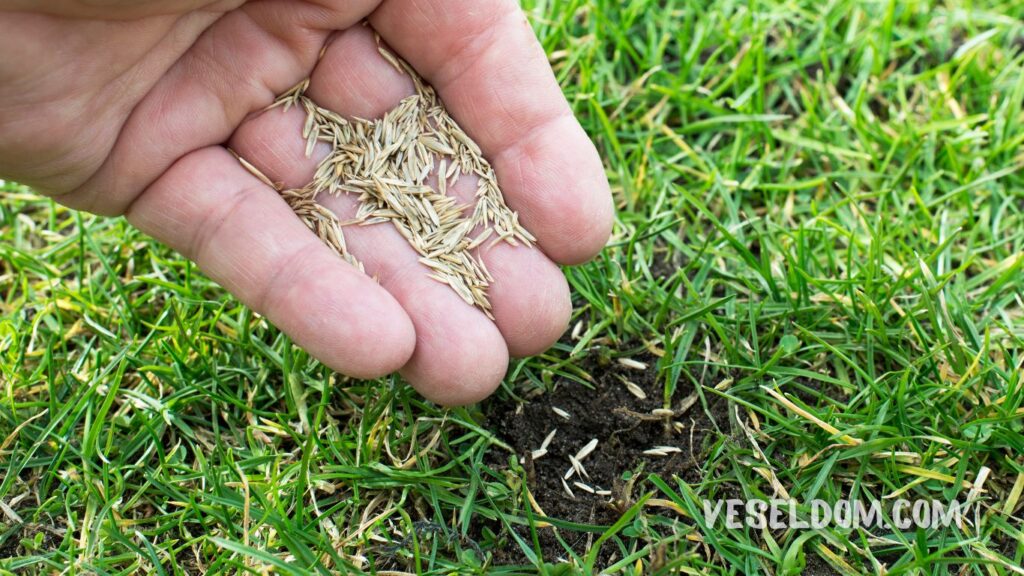
After distributing the seeds on the site, it must be buried in the soil. Usually, an ordinary rake is used for this, easily plowing the sown territory to a depth of no more than 10 mm. However, some gardeners prefer to leave the seeds on the surface of the soil and simply lightly tamp the area, claiming that this way the grass will germinate faster. Usually, the first shoots of various grasses can be seen already a week after sowing (but in the case of some mixtures for Moorish lawns with wildflowers, this period can last a little longer).
Peculiarities of care
Caring for a lazy lawn is easier than for a parterre or sports lawn, but decorative grass still needs a number of mandatory procedures. First of all, we are talking about watering, fertilizing and cutting, in addition, the lawn needs to be loosened from time to time, weeded and renewed.
Watering
As long as the various herbs have not come up and taken root, watering the area should be done very carefully so as not to disturb the even distribution of the seeds and not to sink them into the soil. If the seed distribution is uneven, it can negatively affect the final appearance of the lawn. On the other hand, the lawn should not be left without watering, as this can cause the soil to dry out. It is recommended to moisten the area with the help of special fine-jet sprinklers. However, if the sowing is carried out in a good period before the rains of the autumn season, this stage of care can be limited.

A landscaped lawn needs constant watering. Dry grass quickly turns yellow, and it is difficult to restore the attractive appearance of the lawn afterwards. Daily watering on hot summer days is optimal. It is recommended to water the lawn in the morning or in the evening (the first option is better, because the lawn will look fresh all day) to avoid burning the tender stems.
The rate of water consumption is determined depending on the temperature conditions, but in general, it is necessary to focus on the need to moisten the soil to a depth of 15 cm, which will ensure sufficient moistening of the root system of grass meadow grasses. This is usually enough to keep the lawn in good condition.
Do you know? The German chemist Justus von Liebig is considered the pioneer of mineral fertilizers. During his experiments, the scientist discovered that the growth and fruiting of some plants directly depends on the presence of nitrogen, potassium and phosphorus in the soil, about which in 1859 he published a whole monograph, which, however, was initially received quite skeptically.
Fertilizer and top dressing
In order for the lawn to look good, it needs to be constantly fed. In addition to the already mentioned starter feeding, there are two more varieties of it – seasonal and stress. The first option involves use during the entire vegetation period with equal intervals (sometimes up to twice a month), the second is necessary to help the herb cope with adverse weather conditions – severe frost or drought. Such feeding is carried out on a case-by-case basis, as necessary.
Depending on the condition of the grass and the desired appearance of the lawn, the composition of mineral fertilizers can and should be combined. For example, in the spring period, emphasis is placed on phosphorus and potassium, since these elements have a beneficial effect on the root system and stimulate the active growth of shoots. Also, at the beginning of the season, you can increase the proportion of nitrogen in top dressing, which contributes to faster grass growth and preservation of the spectacular emerald color. In addition to the three named components, a good lawn cannot be grown without constant application of iron: this mineral supports the continuous growth of cereals and their ability to resist various pests.
It is important to remember that phosphorus remains in the soil longer than potassium, so the second mineral element needs more frequent application. Nitrogen should not be used during autumn fertilizing, it can significantly slow down the wintering of the grass and its subsequent growth in the spring.
The following important rules should be followed when applying fertilizers:
- At the time of fertilizing, the grass should be dry, and the soil should be moist.
- It is best to use fertilizers after cutting.
- After completing the fertilizer application procedure, the lawn should be abundantly watered.
Haircut
A lazy lawn is good because it does not need frequent mowing, but to maintain the length of the stems at an optimal level of 4-7 cm, this procedure must be carried out several times during the season. Mowing is necessary not only to make the grass look neat, but also to provide the lawn with a thick and uniform cover. In addition, the timely shortening of some types of weeds prevents them from blooming and scattering seeds on the lawn, which helps to avoid the problem of weeding – high-quality forbs simply displace “competitors” from the plot.
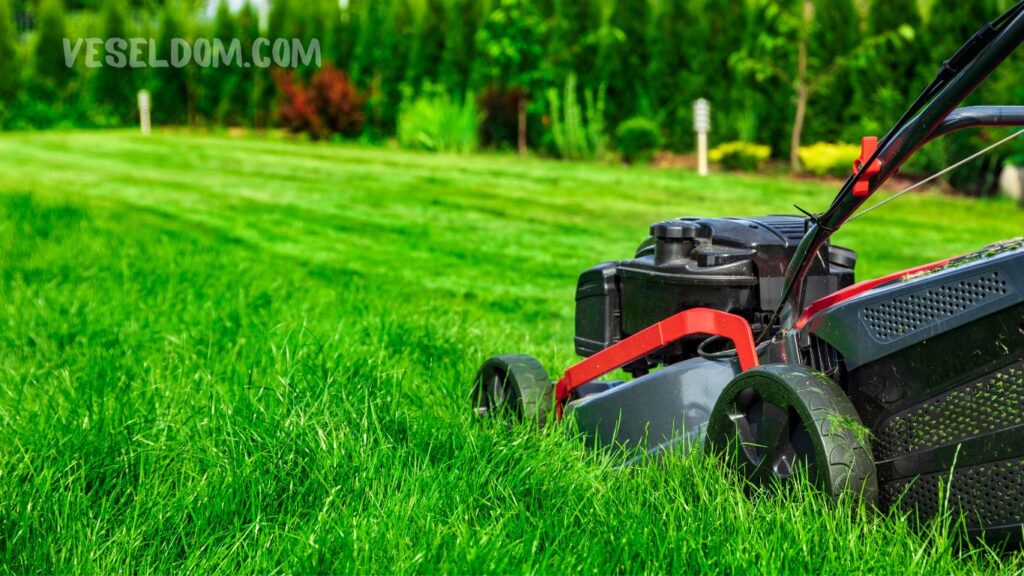
It is considered that it is time to start mowing when the grass has risen higher than 10-12 cm in some areas of the lawn. A dry and overcast day should be chosen for the procedure: it is inconvenient to use a lawnmower on wet ground, and with strong sun, freshly cut grass tips dry out. wither and lose their decorativeness. In autumn, before going into winter, the last haircut is carried out, but at the same time, the grass cannot be shortened too radically, otherwise there is a risk of freezing of the roots on bare soil. Therefore, it is recommended to reduce the frequency of mowing and cut the grass by only 2-3 cm in order to provide the lawn with the necessary thermal protection for the winter.
Aeration
Aeration is a specific lawn care procedure that involves airing the soil in order to saturate it with oxygen. It is performed by the method of piercing the ground at evenly spaced areas, which allows air and water to penetrate into the ground through the holes obtained in this way. It is best to carry out aeration according to the following scheme: the first time – in early spring, the second time – after the penultimate haircut. The main condition is that the grass at the time of piercing the turf should be in the stage of active growth.
An unscheduled aeration procedure is necessary in emergency cases when:
- Prolonged rains overmoisten the ground, which begins to lead to the rotting of the roots of cereals (the holes contribute to the evaporation of water and, thus, dry the soil).
- As a result of a severe drought and a long break in watering, the soil becomes too hard, and the water simply cannot reach the root system, but simply drains from the lawn.
- The lawn was prone to intense trampling and for this reason lost its decorativeness.
In addition to aeration, the classic method of lawn care involves such a procedure as loosening, which is accompanied by cutting the root system of various grasses, which, in turn, stimulates its growth. This method helps to destroy the dense layer of dried sod that covers the ground on its surface and prevents the penetration of water and oxygen into the depth of the soil. After aeration and loosening, combing or, in scientific terms, scarification of the lawn is recommended, i.e. removal of weeds, dead grass, moss and possible debris that has fallen on the lawn.
Sowing and renewal of grass
Even very thorough care of the lawn does not guarantee its owner from the fact that over time the green area begins to be covered with bald spots. This problem arises especially often if the lawn is used for recreation, picnics or, even more so, sports games. It can be solved with the help of timely sowing. It is best to sow with the same grass mixture that was used to lay the lawn in the first place. The second admissible option is the purchase of complexes with a similar composition or separately those types of plants that were part of the original mix.
Do you know? Our ancestors believed that clover brings good luck, so its dried leaves were often used as a talisman. In addition, this plant was attributed with such magical properties as removing damage, getting rid of illness, poverty and other troubles.
However, there is an alternative method that allows you to restore the lawn more quickly. Instead of low-growing and slow-growing plants, which usually form the basis of mixes for lazy lawns, grasses with a high growth rate are used. Sowing can be carried out at any time of the year, although the optimal, for obvious reasons, are the same terms as for the primary planting of various herbs.
The seeding procedure is performed in the following sequence:
- Cut the entire lawn or only its problem areas, while in bald places the vegetation should be shortened as much as possible.
- Remove mowed grass and weed weeds from the treated area.
- Perform shallow loosening of exposed areas (for this purpose, a pitchfork, hoe or cultivator are suitable).
- Carefully level the soil.
- Sow the purchased seeds on the bald spot as densely as possible (recommended seeding rate is doubled on average).
- Cover the sowing area with a thin layer of peat.
- Lightly compact and roll the platform.
- Abundantly, but using a fine spray, water the entire lawn completely to smooth out any possible irregularities.
Sowing can be done on the entire lawn if there are no obvious bald spots on it, but in general the grass grows rarely and irregularly. In this case, the method is somewhat different:
- Complete loosening of the site with a 15-20 mm rake (it’s okay if the growing cereals suffer a little).
- Mix the purchased seeds thoroughly with fertile soil in a ratio of 1:2.
- Distribute the obtained substrate on the lawn in the same order as during regular sowing (the rate of sowing is two times less than specified by the manufacturer).
- Water the lawn abundantly.
Sometimes it happens that you want to replace the originally planted plants. For example, instead of a standard lawn, a Moorish-style lawn may be the solution. Such an update is possible, and for this it is not necessary to get rid of grass already growing on the site. It is enough to do the same actions as in the case of uniform sowing, but at the same time, use new seeds. For example, practically all types of clover in practice very quickly and reliably displace grasses. Therefore, the “Lazy Lawn” mixture is perfect as a replacement for “Lilliputs”.
Despite its promising name, a lazy lawn is a site decoration that requires attention and care. But if you know all the secrets of organizing such a lawn, don’t be lazy to work hard at the initial stage of planting it and choose the right seeds for these purposes, the result will definitely pay off all the efforts invested.